


Real property tax exemption may require equitable ownership analysis
Vol. 81, No. 5 / September-October 2025

Matthew Wine is an of counsel attorney at Spencer Fane LLP in the firm’s Real Estate Practice Group. He focuses his practice on commercial and residential real estate development as well as tax credit incentive financing related to commercial and affordable housing developments, state and federal regulatory counseling, financial services, and general construction and development matters. Wine can be reached at mwine@spencerfane.com.
Under Missouri law, real property tax exemption is available to certain eligible properties, including those used for purely charitable, educational, or religious activity.1 The property must be used for and operated strictly for charitable purposes and must not be held for private or corporate profit.2
Missouri courts have held that where a charitable organization is an equitable owner of the property rather than the fee simple title owner, a property can still qualify for real property tax exemption.3
Equitable ownership in real property tax exemption analysis has been established to mean an entity other than the fee title owner possesses rights in a property that can include the right to have fee interest in the property transferred.4 The courts and tax commissions in recent rulings have indicated a preference that real property tax exemption should be more focused on the actual charitable use of a property and not fee title ownership by creating a pathway to permit properties to benefit from real property tax exemption.
Where state statute has ownership requirements, the Missouri courts have expanded ownership beyond simple fee title ownership to include “equitable ownership.”5
 A property that has an equitable owner that is a not-for-profit organization and otherwise satisfies statutory requirements is real property tax exempt. In the case where the form of ownership is the only question, a local assessor’s office, responsible for determining a property’s eligibility for tax exemption, risks relying on the false assumption that if a property is not owned in fee title by a not-for-profit organization, the property cannot be exempt from real property taxes. That assumption is not supported by current Missouri case law or recent Missouri State Tax Commission (STC) decisions.
The assessor may not be as familiar with the concept of equitable ownership or the current Missouri law surrounding real property tax exemption that permits equitable ownership; therefore, properties equitably owned by not-for-profit organizations, regardless of fee title ownership, should highlight for the assessor how they are the equitable owner and thus satisfy the state’s requirements.
The use and occupation of property have significant influence over determination of a property’s potential tax exemption status, but questions of property ownership also play a predominant role.
If ownership is a special purpose not-for-profit entity created for a purely charitable purpose, then on its face the property complies with Missouri statutes for claiming real property tax exemption.6 However, within the statutory framework, factual context can make the determination more complex. For example, Missouri statute provides that real property held for investment is taxable even if the proceeds from the property are used for religious, educational, or charitable purposes.7
This article is specifically concerned with property tax exemption under a form of ownership beyond simple fee title. While assessors and lawyers may have limited experience with ownership analysis beyond review of the fee title, they may not rely on a simple binary choice where if the fee title is owned by a not-for-profit organization, the property is tax-exempt (subject to use analysis), and if it is not owned by a not-for-profit corporation, then it is subject to real property taxes. That analysis falls short of what Missouri law permits and requires.
Missouri statute
The Missouri statute related to real property tax exemption for charitable purposes provides that:
All property, real and personal, actually and regularly used exclusively for religious worship, for schools and colleges, or for purposes purely charitable and not held for private or corporate profit, except that the exemption herein granted does not include real property not actually used or occupied for the purpose of the organization but held or used as investment even though the income or rentals received therefrom is used wholly for religious, educational or charitable purposes.8
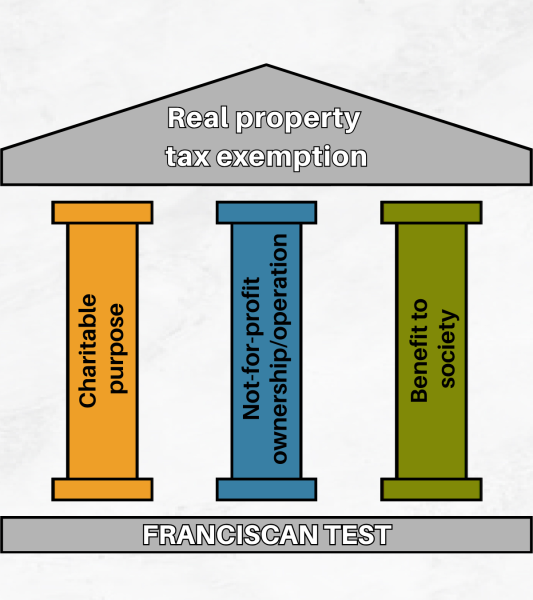 The Supreme Court of Missouri has established criteria for determining the tax status of property under § 137.100(5).9 Commonly referred to as the Franciscan Test, the court held: (1) the property must be dedicated unconditionally to charitable activities; (2) the property must be owned and operated on a not-for-profit basis; and (3) the dominant use of the property must be for the benefit of an indefinite number of people and there must be a direct or indirect benefit to society.10 The charitable use exemption, which also applies to religious uses, depends upon the use made of the property and not solely on the stated purposes of the owner.11 To claim exemption, it will be necessary to meet all three prongs of the Franciscan Test.12
Disputes are likely to occur under the second prong of the test related to ownership, particularly in cases where not-for-profit organizations occupy a property but do not necessarily possess fee simple title to the property. While fee simple ownership would be determinative and leave no dispute, Missouri courts have found “equitable ownership” to be satisfactory for the purposes of meeting the Franciscan Test and establishing real property tax exemption.
However, parties in tax exemption cases should keep in mind some general perspectives when pursuing tax exemption. First, “[t]ax exemptions are not favored in the law and statutes granting exemptions are to be strictly, yet reasonably, construed against the one claiming the exemption.”13 Second, each tax case will necessarily be fact-specific and determined through an evaluative process based “[u]pon the particular record presented.”14 Third, the taxpayer bears the burden of proof related to seeking affirmative relief:15 “Substantial and persuasive controverting evidence is required to rebut the presumption, with the burden of proof resting on the taxpayer.”16
Missouri case law
The issue of ownership as applied to the Missouri charitable use property tax exemption statute is very nuanced; however, Missouri case law has been thorough and has set forth a definitive rule regarding the form of ownership for assessors to follow when properly assigning tax-exempt status to charitable properties. Missouri case law holds that equitable ownership is an acceptable form of ownership under the Franciscan Test to satisfy the statutory requirements for a property used for purely charitable, educational, or religious purposes to be classified as tax-exempt.
Early case history
State ex rel. Hammer v. Macgurn17
This case analyzed considerations of use and ownership prior to the existence of Missouri’s current charitable use tax exemption statute. Here, the fee title owners of real property leased the property to St. Louis public schools but utilized the rent charged for personal benefit.
The court reasoned that regardless of the use of a property, if the owners derived personal profit and benefit, property tax exemption would not be available to the property. The disallowance of personal profit has been included in the current Missouri statutes that are applicable to charitable property tax exemption considerations;18 however, reliance on Macgurn for legal justification for allowing or disallowing property tax exemption based on the form of ownership is misplaced because it did not provide any legal analysis or holding regarding the form of ownership and its impact on tax exemption.19 Furthermore, Macgurn is not the current applicable legal case precedent as to real property tax exemption for charitable organizations, as these issues were subsequently decided in Baumann and Rollings.
State ex rel. City of St. Louis v. Baumann20
This case established in dicta the allowance of “equitable ownership” in property tax exemption case analysis. This case involved the city of St. Louis possessing a right to redeem fee title to a property through redemption of a certificate of purchase. The city claimed it was exempt from real property taxes due during the period it possessed the right to call in the legal title to the property but prior to redeeming the certificate.
Here, the Court states unequivocally “that the word ‘owned’ in an exemption statute is generally construed to comprehend an equitable as well as a legal ownership.”21 “The Court’s holding in Baumann that the holder of equitable title may be considered the owner of property for tax exemption purposes is in accord with numerous other jurisdictions.”22
 The city received fee title without paying real property taxes that were previously due. The city was vested in equitable title to the property,23 even though a private party owned the fee title for a period that the city was entitled to redeem the certificate of purchase, and because the city is a tax-exempt entity, “neither is public property taxable because the naked legal title is in a private person.”24
Recent case history and STC ruling
Rollings v. Shipman25
Rollings definitively establishes the Missouri precedent that equitable ownership is satisfactory to meet the second prong of the Franciscan Test.
Two individuals, Edward and Mary Lou Harris, owned property that the Wentzville School District leased for its administrative offices. After a failed attempt to purchase the property due to insufficient funds and certain constitutional prohibitions, the school district agreed to a lease-to-purchase contract with the property owners, receiving the title to the property at the end of a 10-year lease. The two individual owners then created a trust to hold the property during the term of the lease, and the trust applied for a property tax exemption. This case ping-ponged through the St. Charles County Board of Equalization, St. Charles County Assessor’s Office, multiple STC hearings, and, finally, ended up in the Missouri Court of Appeals-Eastern District.
Ultimately, the property was deemed exempt because it met the three-part Franciscan Test established by the Supreme Court of Missouri.26
The Court of Appeals rejected the assessor’s contention that the school district – and therefore its charitable use – needed to hold title to the property to satisfy the first prong.
Regarding the second prong, which requires the property “be dedicated unconditionally to the charitable activity in such a way that there will be no profit, presently or prospectively, to individuals or corporations,” the court found the district had equitable title as owner and “that the holder of equitable title may be considered the owner of property for tax exemption purposes.”27 The assessor also claimed the lease payments to the trust were evidence of profit: “Whether property is used for profit depends on the intent of the owner in using the property.”28
Based on the third element of the Franciscan Test,29 there was no question that the property would benefit multiple students. The court surmised that the assessor was mistakenly focusing on the sale of the property at the end of the lease term and the party selling rather than the buyer (the school) and the intended and actual use of the property.
The court held that the property was exempt from property taxes even though the trust held legal title to the property because the district was the equitable owner and used it for charitable purposes.
Thomas L. Potter, Sr., & Linda Potter, Complainants v. Rick Kessinger, Assessor, Greene County, Missouri, Respondent30
Thomas and Linda Potter, Christian missionaries and religious teachers returning to the U.S. after 20 years of work abroad, purchased a single-story church building in Greene County that had been used exclusively as a church. The Potters purchased the property so Great Hope Gospel Ministries could operate a Christian church. The property had been exempted from taxes for 77 years due to a history of religious use.
The assessor strictly interpreted Missouri law to indicate that the property must be owned and operated on a not-for-profit basis, and the Potters owning the property as individuals did not qualify the property for tax exemption.
The STC only required an analysis of the second prong of the Franciscan Test: whether the subject property is “owned and operated on a not-for-profit basis.” To satisfy this element, the property:
must be dedicated unconditionally to the charitable activity in such a way that there will be no profit, presently or prospectively, to individuals or corporations. Any gain achieved in use of the building must be devoted to attainment of the charitable objectives of the project.31
The Potters supported their case with Sims v. O’Flaherty, Assessor for the County of Jackson, Missouri.32 Sims has a factual background strikingly similar to the Potter case. The Jackson County assessor argued that because the property was vested in a private individual rather than a not-for-profit, it could never satisfy the second prong of the Franciscan Test.33 The STC reasoned that:
the use of the property was the determinative factor to consider for exemption. … In light of the Jackson County Assessor’s argument concerning ownership, the STC explained that neither the Missouri Constitution, the statute, nor the Franciscan test created a condition based on the form of ownership to qualify for exemption.34
In Potter, the STC recites a rule set forth by the Rollings court that where properties are owned and operated exclusively for charitable purposes, but fee simple title is not necessarily owned by a not-for-profit organization, equitable ownership is acceptable for real property tax exemption.
Notably, however, Missouri courts have held that the equitable owner of a property can be considered the owner for tax exemption purposes.35 Missouri courts have also held that, for taxation purposes, the term “ownership” does not have a fixed, definite meaning.36
The STC accepted the Court’s Baumann ruling that provided “the word ‘owned’ in an exemption statute is generally construed to comprehend an equitable as well as a legal ownership.”37 There was substantial evidence supporting a determination that the property was purchased for and being operated for not-for-profit purposes, and the ruling stated:
The totality of this substantial evidence leads to the reasonable inference that GHGM, the operator of the subject property, has been the beneficiary of [the Potters’] monetary and physical investment in the subject property. Such evidence leads to the equally reasonable inference that, for all practical purposes, GHGM has dominion and control over the subject property while [the Potters] have acted as patrons of the subject property.38
However, the STC distinguished Potter from Rollings and went against precedent in Sims by leaning on the more informal nature of the relationship between the Potters and GHGM, ultimately denying property tax exemption because there was no formal agreement established with the complainants as to legal right of sole possession of the property, requiring the church to maintain and insure the project, or preventing the individual applicants from selling the property and depriving the church of its use.39
Potential tax-exempt structure with equitable ownership
 What would an acceptable equitable ownership structure look like that would qualify for real property tax exemption? There are innumerable hypotheticals that may be in practice today and not at issue with assessors already aware of and accepting the equitable ownership analysis. For those situations where there is uncertainty or friction due to lack of understanding or undertaking the analysis, a simple sale-leaseback structure involving a not-for-profit entity on both sides of the transaction is an example that would satisfy all components of the Franciscan Test and therefore be eligible for real property tax exemption.
Sale-leaseback structure
A sale-leaseback structure may provide for the clearest hypothetical analysis in Missouri, although it has been generally accepted in other jurisdictions.40 It can also provide many benefits.
First, rental terms could be negotiated that are more advantageous to a not-for-profit operating with a limited budget, thereby freeing up capital for charitable purposes when traditional mortgage, financing, or leases with a for-profit landlord are more expensive. Second, the charitable 501(c)(3) sole member owner of the landlord can find protections from liability that naturally come with the ownership of real property by placing the fee simple title with a limited liability company specifically formed for the sole purpose of holding the real estate fee title. Third, the formation of a limited liability company to hold fee title to the property and serve as landlord allows the not-for-profit sole member of the landlord to consolidate multiple properties under a single umbrella entity for ease of property management and the strenuous financial reporting requirements that come with maintaining 501(c)(3) status.
The business reason is immaterial for determining if a property is tax-exempt so long as the property meets the statutory requirements under Missouri law41 and satisfies the Franciscan Test.42 Assuming the property was already determined to be qualified for real property tax exemption based on prior use, and solely the ownership of the fee title is changing, only the ownership prong of the Franciscan Test requires new evaluation.
Missouri case law under Rollings clearly establishes that equitable ownership suffices to meet the requirements of the Franciscan Test. The appropriate question, then: Does one entity possess equitable ownership of the property even though another entity possesses the fee title?
Evaluating equitable ownership
The case law has not yet established a full contextual test for determining equitable ownership under property tax exemption statutes, but the case law has compiled and evaluated many factors for consideration. The argument that if the fee title is not vested in a not-for-profit owner then it is not eligible for property tax exemption is flatly false under the law and too simplistic an analysis given the courts have held that equitable ownership suffices. The primary factor with the STC has been the existence of a formal, documented relationship between ownership and the not-for-profit organization engaging in use of the property. A formal lease would certainly be a documented relationship between the two parties; however, the lease would need to memorialize a relationship that indicates the not-for-profit has rights and obligations, supporting the concept that it is exercising similar control to that of an owner.
A common sense reading of the lease to determine the reasonable intent of the parties would be required. Factors which could be reasonably supportive of equitable ownership include, but are not limited to:
– the tenant possessing the right to purchase (or repurchase if lease is sale-leaseback) the property;
– a requirement that proceeds from any sale or leasing arrangement be used for charitable purposes;
– the tenant exerting significant authority over the management of the property; and
– lease terms which are provided to the not-for-profit at terms more favorable than the market.
 Where a property is owned in fee title by an entity that is not tax-exempt, but the controlling membership interests of the fee title owner are with a not-for-profit organization leasing the property, and this not-for-profit entity possesses the authority to make administrative and management decisions on behalf of the fee title owner, the claim that equitable ownership properly lies with the not-for-profit would be nearly absolute and would create a significant burden for an assessor to deny tax-exempt status. The assessor must be able to plausibly claim that the relationship still permits the fee title owner to derive profit or argue that the relationship between the fee title owner and the not-for-profit is not adequately formalized. Reliance on which entity possesses the fee title is legally flawed and inadequate.
Conclusion
Under Missouri law, determination of real property tax exemption status based solely on fee title ownership is insufficient. Where there is evidence of equitable ownership by a not-for-profit organization and a property is otherwise occupied and operating for tax-exempt charitable activities, the property can still satisfy all requirements of the Franciscan Test. The property must then be granted exemption from real property taxes.
The spirit of the Missouri statute and established case law is that for a real property to be exempt from real property taxes, it must operate for charitable activities and not derive a profit for its owner. While more nuanced than fee title ownership, equitable ownership is fully recognized as an appropriate ownership form for real property tax exemption under Missouri law, and must be considered by an assessor to determine the tax-exempt status of any given property that claims tax exemption and otherwise satisfies the Franciscan Test.
Endnotes
1 MO. REV. STAT. § 137.100.
2 MO. REV. STAT. § 137.100(5).
3 Rollings v. Shipman, 341 S.W.3d 777, 781 (Mo. Ct. App. E.D. 2011). See also State ex rel. City of St. Louis v. Baumann, 348 Mo. 164, 153 S.W.2d 31, 35 (1941) (quoting Cooley on Taxation (1924) § 667).
4 Furthermore, the Supreme Court of Missouri has noted that often, the word “owner” is “used to describe one who has dominion or control over a thing, the title to which is in another.” Rollings, 341 S.W.3d at 782 (quoting BLACK’S NEW DICTIONARY (Rev. 4th ed.)); State ex rel. City of St. Louis v. Baumann, 348 Mo. 164, 153 S.W.2d 31, 35 (1941) (quoting Cooley on Taxation (1924) § 667). See also, Reinhold v. Fee Fee Trunk Sewer, Inc., 664 S.W.2d 599, 603 (Mo.App. E.D. 1984) quoting Carolan v. Nelson, 226 S.W.3d 923, 926 (Mo. Ct. App. 2007) (“[E]quitable title is the right in the party to whom such title belongs to have the legal title transferred to him upon the performance of a specified condition.”).
5 Rollings, 341 S.W.3d at 781.
6 MO. REV. STAT. § 137.100.
7 Tax aspects of not-for-profit corporations, 26 MO. PRAC., BUSINESS ORGANIZATIONS § 35.4 (2d ed.).
8 MO. REV. STAT. § 137.100(5).
9 Franciscan Tertiary Province of Missouri, Inc., v. State Tax Commission, 566 S.W.2d 213, 224 (Mo. banc 1978).
10 Id.
11 Exemption, 18A MO. PRAC., REAL ESTATE LAW—TRANSACT. & DISPUTES § 65:11 (3d ed.).
12 If part of the property satisfies the Franciscan Test while another part does not, it is still possible to qualify for the exemption for the part that does; however, one must accept the assessor’s evaluation or, if this is unacceptable, appeal it through the administrative channels and exhaust administrative remedies. Exemption, 18A MO. PRAC., REAL ESTATE LAW—TRANSACT. & DISPUTES § 65:11 (3d ed.).
13 Potter v. Kessinger, 2018 WL 1863208, at *4 (Mo. St. Tax. Com. Apr. 10, 2018) (citing Missouri Church of Scientology v. State Tax Commission, 560 S.W.2d 837, 844 (Mo. banc 1987); State ex rel. Union Electric Co. v. Goldberg, 578 S.W.2d 921, 923 (Mo. banc 1979).
14 Potter, 2018 WL 2863208, at *4 (citing Rollings v. Shipman, 341 S.W.3d 777, 780 (Mo. App. E.D. 2011).
15 Id.
16 Cohen v. Bushmeyer, 251 S.W.3d 345, 348 (Mo. App. E.D. 2008). Substantial evidence can be defined as such relevant evidence that a reasonable mind might accept as adequate to support a conclusion. Potter at 5 (citing, Cupples Hesse Corp. v. State Tax Commission, 329 S.W.2d 696, 702 (Mo. 1959)).
17 86 S.W. 138 (Mo. 1905).
18 MO. REV. STAT. § 137.100(5).
19 Rollings, 341 S.W.3d at 784–85 (“we note that the decision in Macgurn predated Baumann, and the Court did not consider the issue of equitable ownership”).
20 348 Mo. 164, 153 S.W.2d 31 (1941).
21 State ex rel. City of St. Louis v. Baumann, 348 Mo. 164, 153 S.W.2d 31, 35 (1941) (quoting Cooley on Taxation (1924) § 667).
22 Rollings v. Shipman, 341 S.W.3d 777, 782 (Mo. Ct. App. E.D. 2011).
23 State ex rel. City of St. Louis v. Baumann, 348 Mo. 164, 169, 153 S.W.2d 31, 35 (1941) (“The right to call in the legal title ordinarily presupposes an equitable title in the person who may exercise the right.”).
24 Id.
25 341 S.W.3d 777 (Mo. Ct. App. E.D. 2011).
26 Franciscan Tertiary Province of Missouri, Inc. v. State Tax Commission, 566 S.W.2d 213 (Mo. banc.1978).
27 Rollings, 341 S.W.3d at 782.
28 Victory Christian Church v. Dept. of Revenue, 264 Ill. App. 3d 919, 201 Ill. Dec. 874, 637 N.E.2d 463, 465 (1 Dist.1994).
29 Barnes Hosp. v. Leggett, 589 S.W.2d 241, 244 (Mo. banc 1979) (citing Franciscan, 566 S.W.2d 213).
30 2018 WL 1863208 (Mo. St. Tax Com. April 10, 2018).
31 Potter at 5 (citing Franciscan Tertiary Province of Missouri v. State Tax Commission, 566 S.W.2d 213, 224 (Mo. banc 1978); Twitty v. State Tax Commission, 896 S.W.2d 680, 684 (Mo. App. S.D. 1995)).
32 Sims v. O’Flaherty, 1985 WL 16062 (Mo. St. Tax. Com. Mar. 29, 1985).
33 Id. at *6.
34 Potter, 2018 WL 1863208, at 8.
35 Rollings, 341 S.W.3d at 781.
36 Id.
37 Potter, 2018 WL 1863208 at 8.
38 Id. at 10.
39 Id. (citing Rollings, 341 S.W.3d at 781-83).
40 See, e.g., Cole Hospital, Inc. v. Champaign County Board of Review, 113 Ill. App. 3d 96 (4th Dist. 1983).
41 See statutory requirements in MO. REV. STAT. § 137.100(5).
42 Franciscan, 566 S.W.2d at 224.