


The role of AI in employment processes
Vol. 80, No. 5 / September-October 2024

William C. Martucci, who holds an LL.M. in employment law from Georgetown University in Washington, D.C., practices globally in complex class action (employment discrimination and wage and hour, including California) and EEOC litigation. Chambers notes “Bill Martucci is worth having on any dream team for employment litigation and policy issues.” His jury work has been featured in The National Law Journal. He is listed in the Euromoney Guide to the World’s Leading Labour and Employment Lawyers and The Best Lawyers in America for Employment and Business Litigation. He teaches multinational business policy and the global workplace at Georgetown University.

Burcu Erbaz defends clients in business and employment litigation matters. She graduated first in her class at the University of Missouri-Kansas City School of Law, where she was on the editorial board of the UMKC Law Review. She also served as a judicial intern in the U.S. District Court for the Western District of Missouri, conducting legal research and drafting memoranda.

Minha Jutt represents clients in business litigation matters, including complex commercial disputes, restrictive covenants and trade secrets, and design and construction. Her experience extends to all stages of litigation, ranging from initial client counseling and fact investigation to dispositive motion practice to preparation for appeal.
Artificial intelligence (AI) has become an integral part of modern business operations, including employment decisions such as recruiting, promoting, and terminating employees.
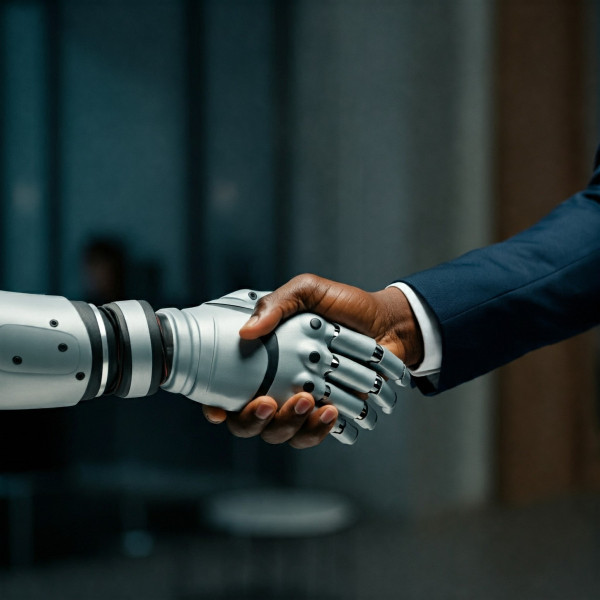 The integration of AI in human resources systems increased efficiency, reduced bias, and enhanced decision-making processes. However, it also raised significant ethical and practical concerns.
This article explores the multifaceted role of AI in these critical employment processes, examining both its benefits and potential drawbacks along with legal landscapes from around the world and the U.S., and some suggestions for Missouri’s evolving legal framework.
What is AI, and how does it impact the global workplace?
Employers may use artificial intelligence for various tasks in the realm of human resources such as recruitment, hiring, promotions, and even termination.
Recruiting1
Recruiting is one of the primary areas where AI has made a substantial impact. Traditional recruiting methods often involve a significant amount of manual work, from sifting through resumes to scheduling interviews. AI can automate many of these tasks, making the process faster and more efficient. AI-driven tools can parse through thousands of resumes in a fraction of the time it would take a human recruiter. These tools use natural language processing (NLP) to identify relevant skills, experiences, and qualifications, ensuring that only the most suitable candidates are shortlisted.
AI-powered chatbots2 are increasingly used for initial candidate engagement. These chatbots can answer common questions, provide information about the company and the position, and even conduct preliminary assessments. In addition to saving time for recruiters, this also enhances the candidate experience by providing prompt responses.
AI can leverage predictive analytics to assess a candidate’s potential fit within a company. By analyzing data from previous hires, AI can identify patterns and characteristics that predict success in a given role. This can help recruiters make more informed decisions and improve the quality of hires.
 Promoting3
AI can also play a significant role in promotion decisions within organizations. Traditional promotion processes can be subjective, often influenced by unconscious biases and limited visibility into an employee’s overall contributions. AI offers a data-driven approach that can help mitigate these issues.
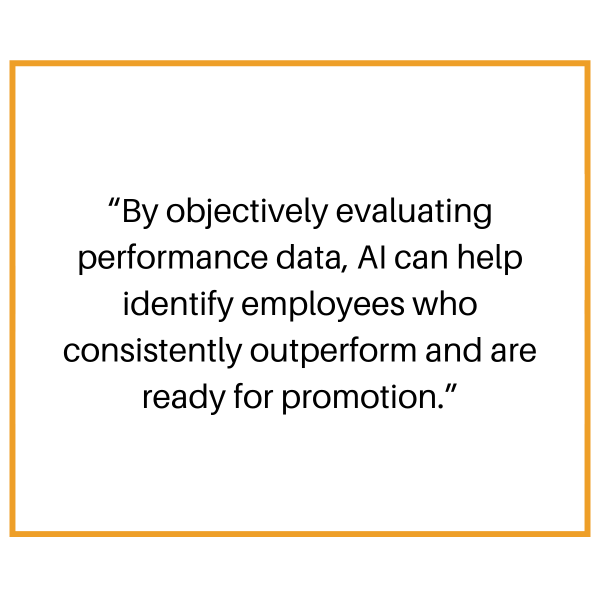
AI systems can analyze vast amounts of performance data to provide a comprehensive view of an employee’s contributions. This includes quantitative metrics such as sales numbers, project completions, and qualitative assessments from peer reviews and feedback. By objectively evaluating performance data, AI can help identify employees who consistently outperform and are ready for promotion.
AI can also perform skill gap analysis to determine whether employees possess the necessary skills for higher-level roles. By mapping current skills against those required for promotion, AI can identify areas where employees need development, helping organizations create targeted training programs to prepare employees for advancement.
One of the most significant advantages of using AI in promotion decisions is its potential to reduce bias. AI systems can be designed to focus solely on performance data, eliminating factors such as race, gender, and age from consideration. However, engaging AI in such roles is a double-edged sword. It is crucial to ensure that the data used to train these AI systems is free from historical biases to prevent perpetuating existing inequalities.
Termination4
The use of AI in employee termination is perhaps the most controversial aspect of AI in human resources. While AI can provide data-driven insights that inform termination decisions, it also raises significant ethical and legal concerns.
AI systems can continuously monitor employee performance, providing real-time feedback and identifying underperformance issues early. This can lead to more proactive management interventions, such as additional training or role adjustments, potentially preventing the need for termination. AI can also analyze behavioral data, such as communication patterns, collaboration metrics, and engagement levels, to identify employees who may be disengaged or at risk of leaving. This information can help managers take preemptive action to address underlying issues or make informed termination decisions when necessary.
Foreseeable risks of discrimination
Disparate treatment and disparate impact
Despite its potential benefits in human resources, AI tools do not come without the foreseeable risks of discrimination. In employment, AI is a double-edged sword; its output is only as good as its input — meaning that AI’s outcomes reflect the algorithm written by its programmers and the data on which the algorithm relies. If a programmer uses the current pool of employees as its data pool, for example, the algorithm will apply the employer’s existing biases and preferences in screening and selecting applicants. The algorithm could disfavor attributes that were not represented in the current pool of employees, which may risk a disparate impact if the existing pool is not diverse. Or, if a programmer defines metrics of success on criteria that disfavor a protected group, such as certain extracurricular activities, the AI system may screen for applicants who meet those characteristics.
A programmer might not avoid the risk of discrimination by removing protected characteristics from the equation, however, as there still remains a risk of disparate impact. When AI tools are programmed with high volumes of data, they may make selections based on proxies for protected characteristics. For example, an algorithm may pose a risk of race discrimination by using proxies for race such as residential zip code, languages spoken, membership in race-based extracurricular or professional organizations, or educational institutions attended. In evaluating video interviews, an algorithm may screen out applicants based on arbitrary characteristics including hand placement, pose, gestures, and tone, potentially screening out those with certain disabilities.5 AI tools may also make inferences based on protected characteristics. These choices may pose a risk of disparate treatment when a proxy is used to disfavor a protected group. And even when these choices might not rise to the level of disparate treatment, they may cause a disparate impact when the disfavored trait correlates with protected characteristics in an unexpected way.
The use of AI in advertisements poses an additional risk of discrimination. Title VII of the Civil Rights Act makes it unlawful for employers to publish advertisements that “indicate a preference, limitation, specification or discrimination” based on a protected characteristic including race, color, religion, sex, and national origin.6 The Age Discrimination in Employment Act (ADEA) contains a similar prohibition regarding age.7 An employer may run afoul of these provisions, for example, by intentionally targeting advertisements that either directly or by proxy exclude members of a protected group. Yet, as with hiring, AI tools may target even facially neutral advertisements in disparate ways. If an employer seeks to reach a broad audience but a vendor targets advertisements at certain groups, it may result in liability for the employer.8
Finally, transparency affects the risks of litigation. AI tools pose a “black box” problem in which the tool masks the exact details of the internal processes, including decision-making. The lack of transparency can blur evidence of discrimination, effectively restricting disparate impact claims.
 Who can be liable?
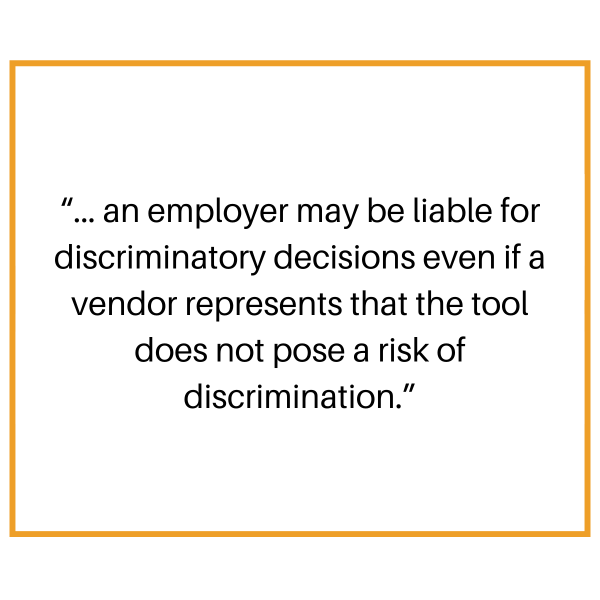
Vendor liability is another factor in the risk equation. An open question remains as to whether a software developer may be liable for violations of employment law when their AI tools produce biased outcomes. Generally, employers are liable for violations of employment law committed by their vendors.9 Under a recent guidance from the U.S. Equal Employment Opportunity Commission, an employer may be liable if it grants the vendor authority to act on the employer’s behalf, administers the selection procedure, or relies on the results of a selection procedure that an agent administers on its behalf.10 Under the EEOC’s interpretation, an employer cannot evade liability for decisions made using tools designed or administered by another entity, such as a software vendor. The EEOC further suggests that an employer may be liable for discriminatory decisions even if a vendor represents that the tool does not pose a risk of discrimination.
Another interesting, unexplored issue arises when a vendor actively deploys its AI tool to facilitate bias. If a vendor exercises control over decision-making to recommend or “bump” certain prospective candidates, applicants, or opportunities, it may have enough direct control to be treated as an “employment agency” under Title VII. In other instances, a vendor may not have enough direct control over decision-making to be liable under Title VII.
Case illustration: Mobley v. Workday, Inc.11
A recent case filed in the Northern District of California addresses the questions of vendor liability and disparate impact in the context of AI tools. Derek Mobley alleged that Workday, Inc.’s algorithm-based applicant screening tools discriminated against him and others similarly situated based on race, age, and disability. Workday filed a motion to dismiss on the basis that it is not a covered entity under Title VII, the ADEA, and the Americans with Disabilities Act. Hon. Rita Lin denied the motion in part, holding that Mobley had plausibly alleged that Workday acted as an agent.
Based on the allegations in the First Amended Complaint, Lin determined that Workday’s customers delegate traditional human resources decisions to the algorithmic decision-making software provided by Workday, including rejecting applicants, such that Workday acted as an agent. In his First Amended Complaint, Mobley alleged that Workday’s software does not merely implement the selection criteria set forth by employers without any input from Workday. Rather, the software participates in the selection procedure by recommending certain candidates and rejecting other candidates. Mobley alleged that he received emails in the middle of the night notifying him that his applications were rejected, which Lin wrote “g[ave] rise to a plausible inference that the decision was automated.” Pointing to these allegations, Lin wrote that Workday’s actions, including “[e]valuating and dispositioning candidates are at the core of the traditional employment functions that the anti-discrimination laws seek to address.”
This interpretation of vendor liability expands the potential liability for companies that create and deploy AI tools used in employment. Under this interpretation, such companies may not be able to simply escape responsibility for biased outcomes yielded by their products by claiming they are just providing a tool. If that tool performs traditional employment functions such as screening applicants, or if the tool participates in the decision- making process by “bumping” particular candidates and rejecting others, the company may be liable as an agent of the employer. Furthermore, this decision may encourage similar lawsuits against AI developers and employers, leading to increased litigation in this area. The ruling provides a pathway for challenging AI-based employment practices under existing anti-discrimination laws.
Ultimately, Lin’s decision in Mobley v. Workday, Inc. is likely to impact the legal landscape surrounding AI in employment. It emphasizes that AI cannot operate in a legal vacuum and that developers and users of AI tools may be held accountable under traditional anti-discrimination laws. This decision could be a catalyst for more stringent regulation and ethical standards in AI development, particularly in areas with significant human impact, such as employment.
Key legislative and regulatory steps around the world and the U.S.
The integration of AI into employment decisions is a rapidly evolving field. Different jurisdictions are grappling with the ethical, legal, and practical implications of AI in these processes, leading to a variety of legislative and regulatory responses.
Global reaction to AI usage in employment
 The European Union has taken a proactive approach in regulating AI, with a strong focus on transparency, accountability, and non-discrimination through the AI Act,12 which includes provisions specifically targeting employment, and the General Data Protection Regulation13 (GDPR), which indirectly impacts the use of AI in employment with its strict data protection rules. Post-Brexit, the United Kingdom has maintained a strong regulatory framework that aligns closely with the EU’s principles but is developing its own AI-specific rules through the Equality Act of 201014 and the Data Protection Act of 2018,15 which complements the EU’s GDPR.
The Canadian Human Rights Act and the Personal Information Protection and Electronic Documents Act provide a framework that addresses discrimination and privacy concerns related to AI in employment.16 Australia’s approach combines existing anti- discrimination laws with emerging guidelines on AI ethics.17 China has issued various guidelines and standards for AI, emphasizing the ethical use of technology and promoting transparency, data protection, and preventing algorithmic discrimination.18
To address the concerns caused by AI usage in employment decisions, several jurisdictions within the United States have enacted or proposed legislation and regulations to govern the use of AI in this field. Illinois was one of the first states to take legislative action specifically targeting AI in employment by enacting the Artificial Intelligence Video Interview Act in 2019, requiring employers to inform applicants that they will be exposed to AI and provide an explanation of how the AI works and what characteristics it evaluates.19 New York City’s Local Law 144, which took effect in 2023, mandates annual bias audits of automated employment decision tools and public disclosure of these audit results.20 The District of Columbia has proposed the Stop Discrimination by Algorithms Act, which aims to prohibit discrimination based on protected characteristics in automated employment decisions.21 Maryland’s Facial Recognition Services Act, effective since October 2020, impacts employers using facial recognition technology in hiring by requiring consent from candidates and disclosure of how the technology will be used and the data it collects.22
At the federal level, there have been significant discussions and proposed regulations, although no comprehensive legislation has been passed. Key initiatives include the Algorithmic Accountability Act23 proposed in Congress, which would require companies to conduct impact assessments, and guidance from the EEOC24 on how existing anti-discrimination laws, such as Title VII, apply to AI in employment decisions.
Missouri’s current legal landscape for the use of AI in employment
In Missouri, as in many jurisdictions, the legal framework surrounding AI usage in employment decisions is evolving, albeit rather slowly. As of 2024, Missouri does not have specific state laws addressing the use of AI in employment decisions. However, companies utilizing AI must navigate existing federal and state employment laws that indirectly impact AI usage, such as Title VII. Employers in Missouri must ensure that AI systems used in recruiting, hiring, or promotion do not result in disparate treatment or disparate impact on protected classes. AI systems must also accommodate individuals with disabilities under the existing ADA.25 Employers must ensure that AI tools do not screen out qualified individuals with disabilities and must provide reasonable accommodations as required. The ADA’s requirements for accommodating individuals with disabilities in the context of AI are covered by the U.S. Department of Justice and EEOC guidelines. Similar to federal anti-discrimination laws, the Missouri Human Rights Act26 prohibits discrimination based on race, color, religion, national origin, sex, ancestry, age, disability, and familial status. AI systems must comply with these provisions to avoid discriminatory practices.
While Missouri currently lacks specific legislation on AI in employment, there have been discussions and proposals at both the state and federal levels that could impact future regulations. There have been initial discussions among state legislators about the potential need for regulations specific to AI in employment. These discussions are driven by concerns over transparency, bias, and accountability in AI systems. Although no formal bills have been introduced, it is likely that future legislation will address these issues.
Missouri employers must also keep an eye on federal legislative trends. The Algorithmic Accountability Act27 proposed in Congress seeks to mandate transparency and accountability for automated decision-making systems, including those used in employment. This act would require companies to conduct impact assessments of AI systems to identify and mitigate potential biases.
Missouri employers should also consider the EEOC’s 2023 guidance on the use of AI in hiring, emphasizing the need for employers to ensure AI tools comply with existing anti-discrimination laws.28
Practical considerations for Missouri employers and steps for internal risk management
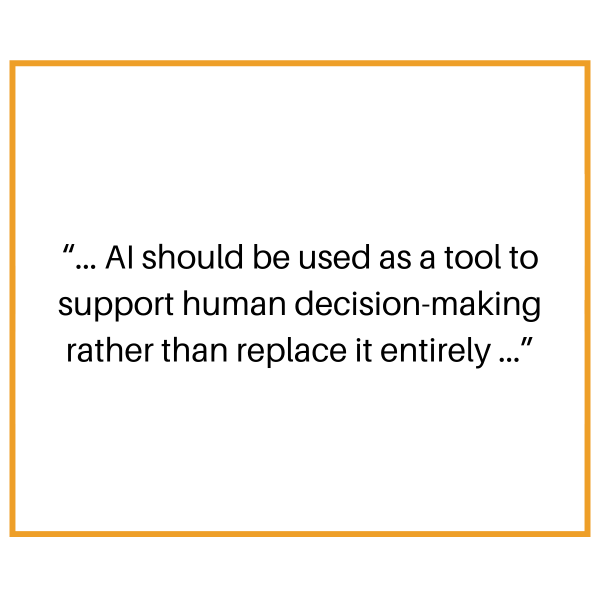
The use of AI in termination decisions must be approached with caution. There are significant legal and ethical implications, including concerns about transparency, accountability, and fairness. Organizations must ensure that their AI systems comply with employment laws and regulations and that employees understand how decisions are being made. Moreover, AI should be used as a tool to support human decision-making rather than replace it entirely, ensuring that termination decisions are made with empathy and considerations of individual circumstances.
 So, when designing or selecting AI tools to screen applicants, employers must evaluate whether those tools unlawfully screen out individuals based on a protected characteristic. Key stakeholders and decision-makers should understand the data, assumptions, and programming used by the vendor and programmer in developing the AI tool. Employers should understand the data pool that the algorithm relies on, as well as any exclusions and limitations of the data. Employers must carefully determine which factors should be used to measure success in applicants, including skills, education, and experience necessary for job performance. Under federal law, employers may use standards for job qualification that are related to the position and consistent with their business necessity. But employers must provide requested reasonable accommodations that will allow applicants with disabilities to meet those standards, unless doing so would be an undue hardship to the employer. If a vendor represents that the AI tool will likely result in lower rates of selection of a protected class, the employer should determine whether the decision-making criteria is consistent with its business necessity and whether any available alternatives may pose less of a risk of disparate impact.
While an audit does not eliminate litigation risk, employers should consider auditing the AI tools to ensure that algorithmic screening does not violate employment discrimination laws, to the extent that an audit is not already required by applicable law.29 Employers should review whether the vendor or programmer tested for disparate impact on protected characteristics, and whether testing is done periodically as data improves. Employers should consider assembling an internal team of qualified professionals to monitor the AI tools being used, including to redress any bias that may become apparent during oversight.
Finally, an employer may allocate risk between it and the vendor through tailoring the parties’ contract. Employers should avoid using standard vendor form contracts that contain broad vendor-indemnity provisions. Employers should consider requiring that all vendors comply with employment law. Other considerations include choice-of-law provisions, venue provisions, and arbitration or alternative dispute resolution.
Suggestions for future Missouri legislation and/or regulation
To mitigate risk of unfair treatment of individuals based on race, gender, age, and other protected characteristics, it is crucial to implement robust regulations that ensure fairness and transparency in AI-driven employment practices. Below are several suggestions for regulating the usage of AI in employment decisions to avoid algorithmic biases.
Mandate algorithmic transparency30
One of the primary concerns with AI in employment is the opacity of decision-making processes. Employers should be required to disclose the criteria and algorithms used in AI systems. This transparency allows for external auditing and ensures that the AI systems comply with anti-discrimination laws. Regular audits are also necessary to ensure compliance with fairness standards. By making these systems more transparent, stakeholders can better understand how decisions are made and identify potential biases.
Implement regular audits and bias testing31
Regular audits of AI systems can help identify and mitigate biases. These audits should be conducted by independent third parties to ensure objectivity. Additionally, bias testing should be performed during the development and deployment stages of AI systems. This involves testing the AI on diverse datasets to identify any discriminatory patterns or outcomes.
Ensure data diversity and quality32
The data used to train AI systems must be representative of the diverse population it will impact. Biased data can lead to biased outcomes, so it is essential to use high-quality, diverse datasets. Employers should be required to assess and improve the quality of their training data continually.
Establish clear accountability and governance structures
To ensure responsible AI usage, companies should establish clear accountability and governance structures. This includes designating specific roles and responsibilities for overseeing AI ethics and compliance. An ethics committee or similar body can provide oversight and ensure that AI practices align with ethical standards and legal requirements.
Provide employee and candidate recourse mechanisms
Individuals affected by AI-driven employment decisions should have access to recourse mechanisms. This includes the ability to appeal decisions, request explanations, and correct inaccurate data. Ensuring that employees and candidates can challenge and seek redress for potentially biased decisions is crucial for maintaining fairness.
Promote ethical AI development and use
Promoting ethical AI involves creating industry-specific guidelines and standards for the responsible development and use of AI in employment. These guidelines should emphasize fairness, accountability, and transparency. Employers should be encouraged to adopt best practices and ethical frameworks for AI usage.
Regulating the use of AI in employment decisions is essential to avoid algorithmic biases and ensure fair treatment of all individuals. Implementing these measures can help create a balanced and fair environment where AI enhances decision- making in employment without perpetuating or amplifying existing biases. By mandating transparency, implementing regular audits, ensuring data diversity and quality, establishing clear accountability structures, providing recourse mechanisms, and promoting ethical AI development, legislators and regulators can help mitigate the risks associated with AI in the workplace. These measures will not only protect employees and candidates but also enhance the overall trust and effectiveness of AI systems in employment practices.
Conclusion
AI has the potential to revolutionize employment decisions, making processes such as recruiting, promoting, and terminating employees more efficient, objective, and data-driven. However, to fully realize these benefits, organizations must address the significant ethical, legal, and practical challenges associated with AI use. By adopting a thoughtful and responsible approach, organizations can leverage AI to enhance their HR practices while ensuring fairness, transparency, and respect for employee rights.
The legislative and regulatory landscape for AI in employment decision-making is complex and rapidly evolving. Jurisdictions around the world and in the U.S. are recognizing the transformative potential of AI while striving to mitigate its risks. Common themes include ensuring transparency, preventing discrimination, safeguarding privacy, and maintaining accountability.
Even though there have been discussions and proposals in Missouri that could create a foundation for future legislation or regulations, Missouri currently lacks specific legislation on AI usage in employment. This gap in Missouri’s legal framework leaves applicants and employees unprotected against companies using AI-driven technology in employment decisions, and employers vulnerable against litigation involving allegations of discrimination and bias. Missouri should catch up with other jurisdictions that have been more active in this area and enact multi-faceted laws to mitigate risks associated with AI in employment decisions.
Endnotes
1 Benjamin Laker, The Use of Artificial Intelligence in Recruiting: The Risks and Rewards, Forbes (July 19, 2021) (www.forbes.com/sites/benjaminlaker/2021/07/19/the-use-of-artificial-intelligence-in-recruiting-the- risks-and-rewards/); Ashwani Kumar Upadhyay & Komal Khandelwal, Applying Artificial Intelligence: Implications for Recruitment, 17 STRATEGIC HR REVIEW 255-58 (2018) (https://www.emerald.com/insight/content/doi/10.1108/SHR-07-2018-0057/full/html).
2 A computer program designed to simulate conversation with human users, especially over the internet.
3 Jeffrey Dastin, Amazon Scraps Secret AI Recruiting Tool That Showed Bias Against Women, Reuters (Oct. 10, 2018) (www.reuters.com/article/us-amazon- com-jobs-automation-insight-idUSKCN1MK08G); Manish Raghavan et al., Mitigating Bias in Algorithmic Hiring: Evaluating Claims and Practices, Proceedings of the 2020 Conference on Fairness, Accountability, and Transparency, 469–81, ACM DIGITAL LIBRARY (Jan. 27, 2020) (dl.acm.org/doi/10.1145/3351095.3372828).
4 Reuben Binns, Fairness in Machine Learning: Lessons from Political Philosophy, Proceedings of the 2018 Conference on Fairness, Accountability, and Transparency, 149-159, ACM DIGITAL LIBRARY (2018) (https://proceedings. mlr.press/v81/binns18a.html); Kolbjørnsrud, V., Amico, R., & Thomas, R. J., The Promise of Artificial Intelligence: Reducing Bias and Improving Performance, Harvard business review (https://hbr.org/2016/10/the-promise-of-artificial- intelligence).
5 Alex Engler, For Some Employment Algorithms, Disability Discrimination by Default, brookings (Oct. 31, 2019) (www.brookings.edu/articles/for-some-employment algorithms-disability-discrimination-by-default/).
6 42 U.S.C. § 2000e-3(b).
7 29 U.S.C. § 623(e).
8 Brittany Kammerer, Hired by A Robot: The Legal Implications of Artificial Intelligence Video Interviews and Advocating for Greater Protection of Job Applicants, 107 iowA l. rev. 817 (2022).
9 42 U.S.C. §§ 2000e(b), 12111(5)(A); 29 U.S.C. § 630(b).
10 Select Issues: Assessing Adverse Impact in Software, Algorithms, and Artificial Intelligence Used in Employment Selection Procedures Under Title VII of the Civil Rights Act of 1964, U.S. EQUAL EMPLOYMENT OPPORTUNITY COMMISSION (www.eeoc.gov/laws/guidance/select-issues-assessing-adverse-impact-software-algorithms-and- artificial#_ednref11).
11 No. 23-CV-00770-RFL, 2024 WL 3409146 (N.D. Cal. July 12, 2024).
12 Proposal for a Regulation Laying Down Harmonised Rules on Artificial Intelligence (Artificial Intelligence Act), EUROPEAN COMMISSION (ec.europa.eu/ newsroom/dae/document.cfm?doc_id=75788).
13 General Data Protection Regulation (GDPR), EUROPEN COMMISSION (gdpr-info.eu/).
14 Equality Act 2010, UK Government (www.legislation.gov.uk/ukpga/2010/15/contents).
15 Data Protection Act 2018, UK Government (www.legislation.gov.uk/ukpga/2018/12/contents/enacted).
16 Canadian Human Rights Act, JUSTICE LAWS WEBSITE (laws-lois.justice. gc.ca/eng/acts/h-6/); Personal Information Protection and Electronic Documents Act (PIPEDA), OFFICE OF THE PRIVACY COMMISSIONER OF CANADA (www.priv.gc.ca/en/privacy-topics/privacy-laws-in-canada/the-personal-information-protection-and-electronic-documents-act-pipeda/).
17 Using artificial intelligence to make decisions: recommendations for AI regulation, AUSTRIALIAN HUMAN RIGHTS COMMISSION (humanrights.gov.au/our-work/rights-and-freedoms/publications/using-artificial-intelligence-make- decisions-recommendations).
18 China’s Approach to AI Governance, DIGICHINA (digichina.stanford.edu/ news/chinas-approach-ai-governance-key-documents-summary).
19 Artificial Intelligence Video Interview Act, IL Public Act 101-0260 (www.ilga.gov/legislation/publicacts/101/101-0260.htm).
20 Automated Employment Decision Tools, NYC Administrative Code, Local Law 144 (www1.nyc.gov/assets/dca/downloads/pdf/about/LL144. pdf); Local Law 144 of 2021, New York City Council (legistar.council.nyc.gov/ LegislationDetail.aspx?ID=4941574&GUID=5F9D9848-01F7-4D97-B68D- BB4AC1E5D6D4).
21 Stop Discrimination by Algorithms Act of 2021, DC Council (lims. dccouncil.us/Legislation/B24-0558).
22 Facial Recognition Services Act, Maryland General Assembly (mgaleg. maryland.gov/mgawebsite/Legislation/Details/hb1202?ys=2020rs).
23 H.R.2231 - Algorithmic Accountability Act of 2019 (www.congress.gov/ bill/116th-congress/house-bill/2231).
24 EEOC on AI in Employment, EQUAL EMPLOYMENT OPPORTUNITY COMMISSION (www.eeoc.gov/newsroom/eeoc-launches-initiative-artificial- intelligence-and-algorithmic-fairness).
25 Americans with Disabilities Act (ADA): [ADA National Network] (adata. org/factsheet/ADA-overview).
26 Missouri Human Rights Act (MHRA): [Missouri Commission on Human Rights] (labor.mo.gov/mohumanrights).
27 Algorithmic Accountability Act: [Congress.gov] (www.congress.gov/bill/117th-congress/house-bill/2231).
28 EEOC Guidance on AI: [EEOC Official Website] (www.eeoc.gov/).
29 Pauline T. Kim, Auditing Algorithms for Discrimination, 166 UNIV. PA. I. REV. online 189, 190 (2017); Anne Cullen, EEOC Stance In Bellwether AI Suit Raises Stakes For Vendors, lAw360 (Apr. 18, 2024) (“If your company uses software, computer systems, etc., created by someone else that discriminates, you will be on the hook, not the vendor,” according to a slide from the training, which was shared with Law360 by an attendee.”).
30 Barocas, S., Hardt, M., & Narayanan, A. FAIRNESS AND MACHINE LEARNING (2019). (fairmlbook.org); Pasquale, F., THE BLACK BOX SOCIETY: THE SECRET ALGORITHMS THAT CONTROL MONEY AND INFORMATION, Harvard University Press (2015).
31 Raji, I. D., & Buolamwini, J., Actionable Auditing: Investigating the Impact of Publicly Naming Biased Performance Results of Commercial AI Products, Proceedings of the 2019 AAAI/ACM Conference on AI, Ethics, and Society (2019); Fairness and Accountability Standards: Selbst, A. D., & Barocas, S., The Intuitive Appeal of Explainable Machines, FordHAM l. rev., 87(3), 1085-1139 (2018); Human Oversight and Intervention: Binns, R., Human Judgment in Algorithmic Loops: Individual Justice and Automated Decision-Making, ETHICS AND INFORMATION TECHNOLOGY, 20, 77-89 (2018).
32 Diversity and Inclusion in AI Development: West, S. M., Whittaker, M., & Crawford, K., Discriminating Systems: Gender, Race, and Power in AI, AI now institute (2019), retrieved from [ainowinstitute.org] (ainowinstitute.org/ publication/discriminating-systems-gender-race-and-power-in-ai-2).