


Meet Missouri’s new chief justice: Q&A with Hon. W. Brent Powell
Vol. 81, No. 4 / July-August 2025
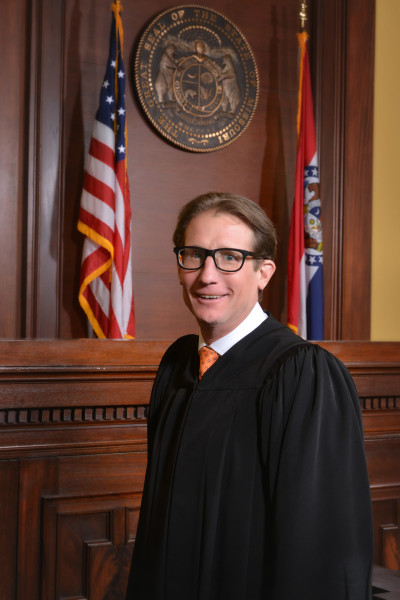 As Hon. W. Brent Powell stepped into the role of chief justice of the Supreme Court of Missouri July 1, The Missouri Bar caught up with him to discuss his priority topics while in the new role, his path to the bench, his passion for civics education, and his guidance for new lawyers.
Why did you want to become a lawyer, and later a judge?
Family history introduced me to the law, and good luck and fortune led to my passion for the law and eventually the judiciary.
After graduating from William Jewell College in Liberty with a political science degree, law school seemed to be the next logical step. When I graduated from the University of Missouri School of Law in 1996, I received and accepted an offer to join the Lathrop & Gage law firm in Kansas City, and I became a member of the firm’s real estate department. While I learned a lot from the experienced lawyers at the firm and thoroughly enjoyed working with exceptional lawyers, I quickly discovered I was not very interested in transactional law.
At that time, my wife worked as a prosecutor in Jackson County. Her love for her job piqued my interest. I applied for an opening at the Platte County Prosecutor’s Office and became an assistant prosecutor. I loved being a trial lawyer. The courtroom was exciting, challenging, and rewarding. By dumb luck, I found my calling. I found the law — or the law found me — at the Platte County courthouse.
But, finding the law was not purely accidental. I grew up around the law. My mother was a probation and parole officer, and my uncle a well-respected lawyer in our hometown of Springfield. My father also is a distinguished lawyer. He is still practicing in the Springfield area after 50-plus years.
So, the legal profession has always played a big part in my life, and my family always held the judiciary in very high esteem. My uncle had a widely varied law practice, handling civil, domestic, and criminal litigation in addition to counseling several area businesses, and the idea of working in a variety of different legal arenas always intrigued me. But it is difficult to have a similarly varied practice in Kansas City, unless, of course, you work in the judiciary.
Tell me about your journey to the Supreme Court of Missouri. What were your first thoughts when you found out you were appointed in 2017?
 After serving as a state and federal prosecutor for more than 10 years, I began applying for vacancies at the Jackson County Circuit Court. In 2008, I had the honor of being appointed circuit judge.
Once I settled into my new job, I learned there were additional ways I could serve. The Supreme Court of Missouri has many standing committees, ad hoc workgroups, and task forces working with various subject matters. As a circuit judge, I served on several of these committees.
I loved debating and collaborating with the other members of these groups, but what I learned about myself is I truly had an interest and a passion for seeking to improve the administration of justice in our state. I also realized I wanted to be one of the individuals sitting around the table analyzing the recommendations from the Court’s various committees, workgroups, and task forces and determining which should be adopted, in whole or in part.
After serving approximately nine years as a circuit court judge, I decided to seek advancement to the Supreme Court of Missouri. I hated to leave the great people I worked with in Jackson County. Like all our trial courts across the state, the Jackson County Circuit Court is made up of a lot of good people doing great work for no notoriety and little pay. But the thought of being able to spend even more time working on the administration of justice really intrigued me, so I threw my hat in the ring and applied for a vacancy at the Court.
Thankfully, every journey to the Court runs through the Appellate Judicial Commission and ends in the governor’s office. I am so very grateful for the confidence the commission members and Gov. Eric Greitens placed in me. But for Missouri’s Non-Partisan Court Plan, I never would have made it to our state’s highest court.
After I received the call from the governor, I called my dad and mom, who has since died, and delivered the news. I will never forget that moment.
 What do you enjoy most about serving on the Court?
I get to work with great people! My colleagues on the Court are fantastic. They are smart, witty, and a few of them can even sing! We are a very collaborative group. We don’t always agree, but we are never disagreeable, and we enjoy our time together.
I also enjoy working with our great staff at the Court. There are a lot of moving pieces in the big red brick courthouse in Jefferson City, and the entire Court family always pulls together to keep the ship upright. I appreciate them all so much.
As an added bonus, I get the opportunity to work with great people at the Office of State Courts Administrator and other judges and court staff across Missouri. They, along with members of The Missouri Bar and other judicial stakeholders, work tirelessly on many of the Court’s various standing committees, ad hoc workgroups, and task forces to improve the administration of justice and operation of our courts.
These are the people who truly inspire me and make me want to get out of bed every morning to get back to work!
What is something you’re looking forward to as chief justice?
Absolutely nothing! My colleagues jokingly refer to our stint as chief justice as a two-year sentence with no chance for parole.
But in all seriousness, I do look forward to continuing the outstanding work and leadership provided by my predecessor, Hon. Mary Russell.
There are many different facets involved in improving our courts and judicial system, but there are a few that led me to apply for a position on our Court. I have championed these issues over the years and hope to prioritize them during my time as chief justice.
 Access to justice
There are too many places in Missouri without enough local lawyers to represent the legal needs of the community. In addition, legal representation has grown far too expensive for many Missourians to afford. Finally, we must ensure everyone, from all walks of life, is treated fairly and justly in our legal system.
Criminal justice reform
We have a mental and behavioral health crisis in our criminal justice system. Our treatment courts have achieved enormous success over the years addressing some of the issues associated with this crisis, and we can build upon these successes in different ways, including by improving and expanding our pretrial release programs.
Non-Partisan Court Plan
Missouri’s Non-Partisan Court Plan has worked well for 85 years to ensure the appointment of fair and impartial judges across our state while keeping the influence of money and partisan politics out of our courts and giving citizens the final say. Dubbed “The Missouri Plan,” this plan has become a model for the nation, with several other states adopting aspects of the plan to improve their court systems. I look forward to working with The Missouri Bar to ensure the success of this plan continues.
What is something you want Missouri lawyers to know about the Supreme Court of Missouri?
The Court has a rich and fascinating history. The Supreme Court of Missouri was created in 1820, with the adoption of the state’s first constitution. Originally, the Supreme Court of Missouri had only three judges. Constitutional changes expanded the Court in 1872 to five judges and again in 1890 to the current seven judges.
For its first 54 years, the Court held arguments in various cities, rotating among Fayette, Jackson, St. Charles, and St. Louis. At various times, the Court also sat at Boonville, Bowling Green, Cape Girardeau, Columbia, Lexington, Palmyra, Potosi, and St. Joseph. It wasn’t until the 1875 Constitution that the Court gained a permanent seat in Jefferson City.
 The current red brick Supreme Court building was completed in 1907 from excess appropriations from the 1904 St. Louis World’s Fair. It is a beautiful building, and I would encourage all lawyers to bring their families to visit and learn more about the building and the Court’s rich history.
What advice do you have for new lawyers?
Pay close attention to, and frequently remind yourself of, the words of your oath of admission as a Missouri lawyer. It requires us to support our federal and state constitutions; to respect courts, judges, and one another; and to serve those who need our help.
As John Adams expressed, ours is a “government of laws, not of men.” This concept is the bedrock of our federal and state constitutions, ensuring that the Rule of Law, not individual men and women, governs our way of life. But the freedoms and justice enshrined in our constitutions are not guaranteed unless we guard, protect, and preserve them. It is our responsibility as lawyers to defend and promote the Rule of Law.
The oath we have taken as lawyers requires us to step up and serve. Diligent and honorable service to your clients, your profession, and your community is what being a lawyer is really all about.
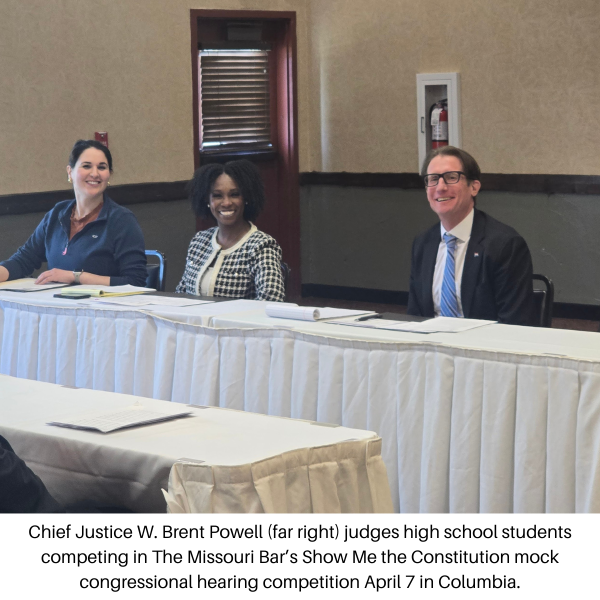
You routinely volunteer for civics education events, like Show Me the Constitution. Why do you believe it’s important for lawyers and judges to be involved in civic education?
Civic education allows lawyers and judges to connect Missourians with their courts and legal institutions — where some of the most important issues in their lives are heard and decided every day.
Missourians are involved in more than 1 million cases each year — just in our state courts. But more people know about pop stars, pop culture, and social media influencers than the three branches of government or how judges decide cases in a court of law. Maybe this is because courts are not a topic of everyday conversation. Civic education creates opportunities for lawyers and judges to engage Missourians in a meaningful dialogue about their courts.
The Missouri Bar and the judiciary have resources available to help. I encourage lawyers to learn more about the bar’s resources at MissouriLawyersHelp.org. Judges can also find resources at Courts.mo.gov/CivicEducation.
What are some fun facts about yourself?
 I grew up in the same neighborhood as actor Brad Pitt. I’d like to say Brad frequently brags to all his friends about knowing me back in the day, but I would be lying.
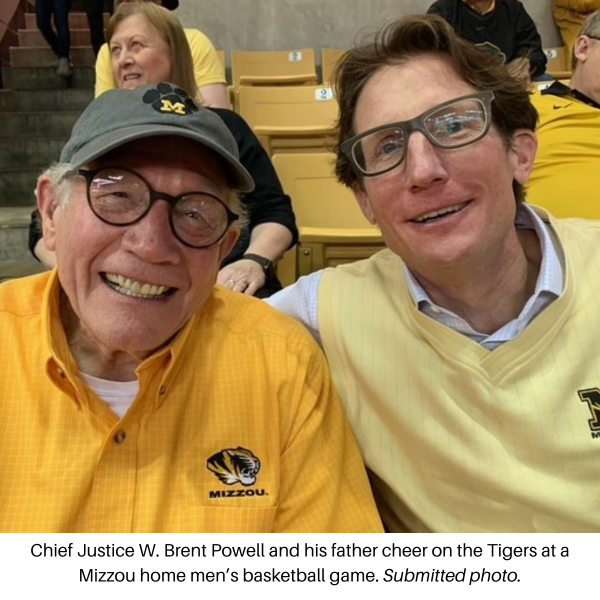
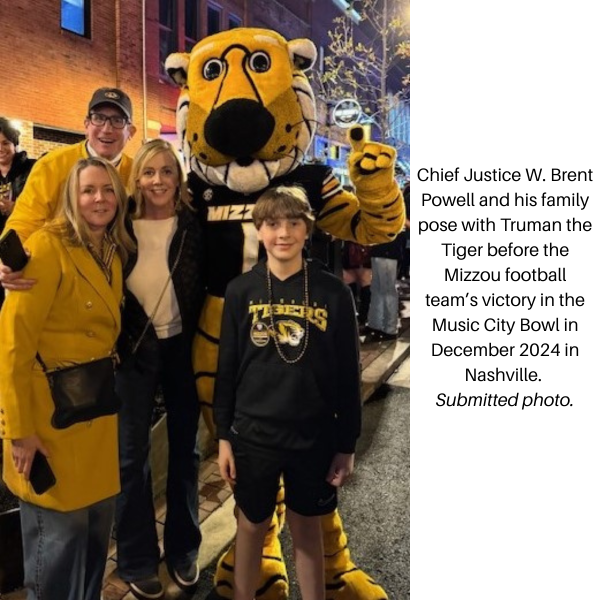
I am a huge Mizzou fan — especially football! My uncle played running back for the Tigers in the ʼ50s under Coach Don Faurot, and my family has been big Mizzou fans ever since.
Is there anything else you would like to add or want Missouri lawyers to know?
I am so proud to be a lawyer. The profession runs deep in my family, so being a lawyer is more than a career or a job to me — it is a way of life.
It makes me proud to see lawyers serving their communities — on school boards, church groups, city councils, and other civic commissions and organizations. Of course, other professionals and community members do their part too, but lawyers provide the necessary guidance and leadership to support these groups in our communities. It makes me proud to see lawyers serving their clients. Whether in the public or private sector, lawyers put their clients’ needs before their own.
It makes me proud to see lawyers serving our state and local bar organizations, engaging with one another at meetings, working on committees and commissions to improve the law, the legal system, and our profession.
In a nutshell, being part of a profession that puts the interests of others before our own, providing tangible assistance to those who need our help, makes me very proud to be a Missouri lawyer. I hope you are, too!