


Missouri among first to administer NextGen Uniform Bar Exam in July
Vol. 82, No. 3 / May-June 2026

Hon. Cynthia L. Martin was appointed to the Missouri Court of Appeals, Western District, in 2009. Prior to that, Martin was in private practice for 25 years as a commercial trial and transactional lawyer. She received B.A. degrees in Communication and Psychology from William Jewell College in 1981 and her J.D. degree from the University of Missouri- Kansas City School of Law in 1984. Martin served on the Missouri Board of Law Examiners from 2001-2011, including as its president when Missouri became the first state to adopt the Uniform Bar Examination in 2010. Martin was appointed to the Board of Trustees for the National Conference of Bar Examiners in 2011 and was chair of the board from 2019-2020. Martin was appointed chair of the NCBE’s Testing Task Force in 2018 and chair of the NCBE’s Implementation Steering Committee in 2021.
In July, Missouri will be one of 10 jurisdictions to first administer the NextGen Uniform Bar Exam.
Developed by the National Conference of Bar Examiners, the NextGen UBE represents an exciting evolution from the Legacy UBE. The Legacy UBE uses three discrete item types to assess doctrinal knowledge in 12 areas, with a limited assessment of legal skills. In contrast, the NextGen UBE will objectively assess foundational lawyering skills and doctrinal knowledge using integrated multiple choice and constructive response items that better approximate the real-world practice of law.
The NextGen UBE will be administered in person over the course of two days twice a year and will be fully computer-based, with the administration time shortened from 12 to nine hours.
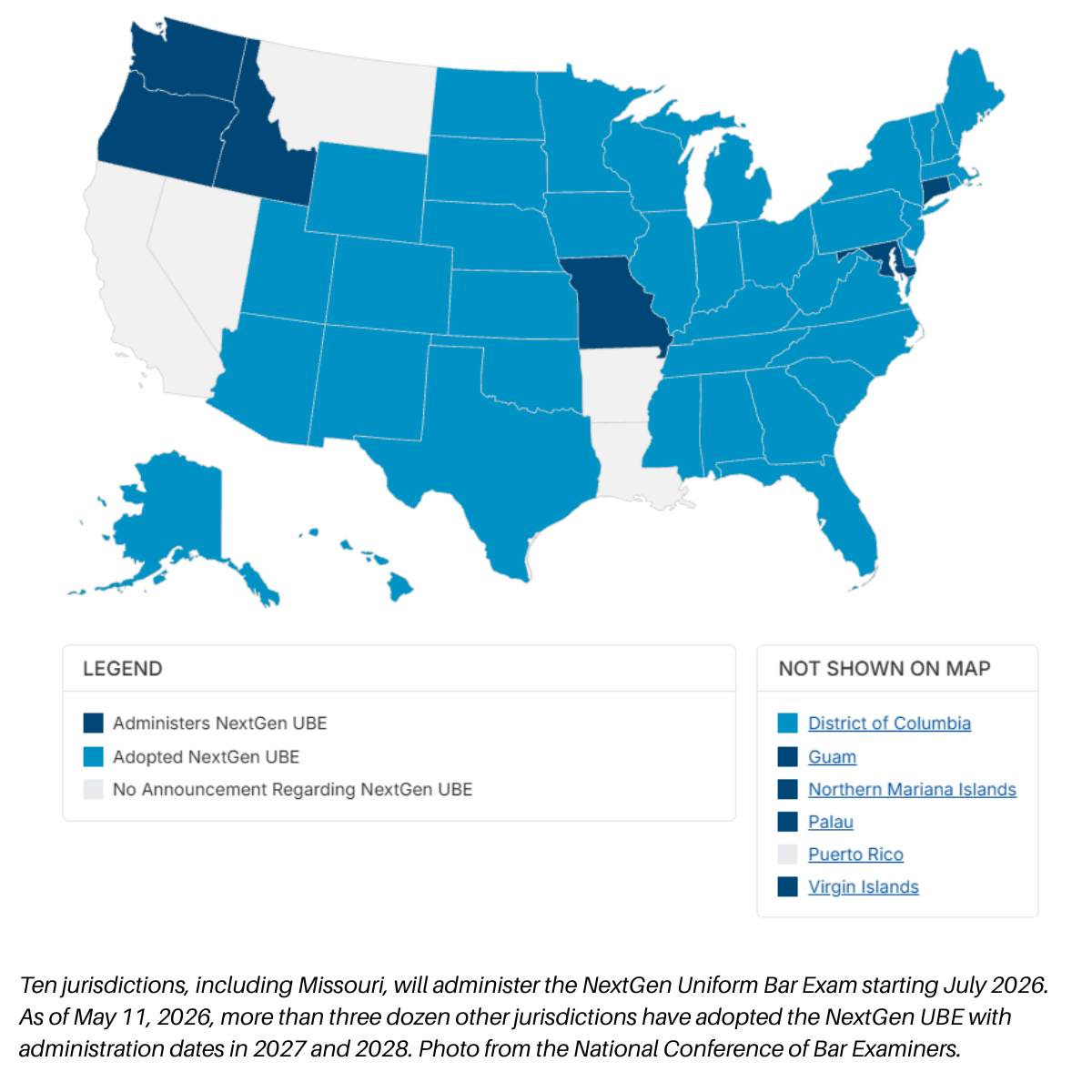 There will be a national rollout of the NextGen UBE, with the transition to be completed by July 2028. As of mid-May, 48 jurisdictions have agreed to administer the NextGen UBE by that time.
Development of NextGen UBE
NCBE’s commitment to the development of a new bar exam followed an intensive three-year research project undertaken by a Testing Task Force, which I had the pleasure of chairing from 2018-2021.
The TTF engaged in a comprehensive and future-focused re-imagining of the bar exam’s content, design, and delivery method, driven by empirical input. The TTF recognized that whatever its recommendations, the bar examination would need to remain tethered to its purpose — to determine whether individuals seeking a general license to practice law have the minimum knowledge, skills, and abilities required to safely provide legal services to the public.
The TTF conducted its research study in three successive phases and utilized independent research consulting firms. Throughout the three-year study, the TTF employed a dedicated website, blogs, published reports, webinars, and conference presentations to transparently describe the progress of its research.
Phase one of the study was committed to listening sessions where the TTF could learn what stakeholders liked and disliked about the Legacy UBE, along with their aspirational goals for a new bar examination.
Phase two involved a comprehensive and widely distributed practice analysis survey that was completed by over 45,000 demographically representative lawyers. The practice analysis identified the job activities of newly licensed lawyers and the knowledge, skills, and abilities required to perform those activities.
Phase three engaged external focus groups to evaluate the data gathered from phases one and two and make recommendations about the content and design of a new bar examination, ever mindful that demonstrated minimum competence on the exam yields a general license to practice law.
This ambitious three-year research study yielded TTF recommendations that were adopted by NCBE’s Board of Trustees in January 2021. The recommendations touched on every aspect of the bar examination, all while remaining committed to the essential principles of high-stakes licensure examinations — validity, reliability, and fairness.
The TTF recommended:
- The objective assessment of a narrower range of foundational doctrinal knowledge and a broader range of lawyering skills
- The use of integrated item types that cross-assess doctrinal knowledge and lawyering skills in a manner that approximates the “real world” practice of law
- Fully computer-based, in-person administration
The TTF projected that implementation of its recommendations would take five to seven years and suggested the formation of the NCBE’s Implementation Steering Committee, which I am proud to chair. The committee worked with NCBE staff to develop NextGen UBE content and the complex infrastructure required to support computer-based administration.
Skills and knowledge evaluated by NextGen UBE
The NextGen UBE will assess foundational concepts and principles in nine doctrinal areas: civil procedure, contract law, evidence, torts, business associations, constitutional law, criminal law, real property, and family law (beginning in July 2028). These doctrinal areas largely transcend discrete practice areas and represent foundational knowledge that every lawyer with a general license to practice law should possess.
In addition, the NextGen UBE will objectively assess foundational skills in seven areas: legal research, legal writing, issue spotting and analysis, investigation and evaluation, client counseling and advising, negotiation and dispute resolution, and client relationship and management. These skills represent the very essence of lawyering and must be drawn upon regardless of practice area.
Content scope outlines for each of these areas have been meticulously curated based on the TTF’s practice analysis and input from content scope experts. The content scope outlines for foundational concepts and principles identify subtopics that are so fundamental they must be recalled without access to a legal library. Other subtopics are demarked to require knowledge sufficient to efficiently identify legal issues and to apply recalled and provided law to facts within the time constraints of a high-stakes licensure exam.
 The NextGen UBE features item types that integrate assessment across multiple knowledge and skills domains at the same time, much like the real-world practice of law where lawyers are rarely presented with a siloed legal question.
Portability of official scores achieved on the NextGen UBE will remain a strongly encouraged practice, with many jurisdictions having already committed to the score portability compact that has been a hallmark of the Legacy UBE.
By the time the NextGen UBE rolls out in July 2026, its content, item types, delivery platform, and every imaginable attribute implicated by migrating to a fully computer-based assessment will have been extensively field-tested, pilot-tested, prototype-tested, and beta-tested by more than 42,000 recent law school graduates. This includes hundreds of recent Missouri law school graduates.
In addition, the unprecedented preparation for a smooth, operational rollout has included exhaustive psychometric evaluation of item and applicant performance, assisted by the facilitated input of practitioners and legal academics from across the country, including Missouri.
As a result, NCBE projects that when administered to a demographically equivalent cohort, the recommended passing score range on the NextGen UBE will align with outcome analyses derived from passing score ranges on the Legacy UBE.
In other words, though the NextGen UBE will be a very different exam from the Legacy UBE, it will not be any more or less rigorous to pass. At the same time, the NextGen UBE has been applauded by the thousands of recent law school graduates and other legal professionals who have already been exposed to its integrated content design and digital delivery platform, because both align with the real-world expectations of newly licensed lawyers. That is exactly what was intended.
Missouri at the frontline of change 
After years of scientific research and implementation, NCBE is now on the eve of the NextGen UBE launch in July 2026. During the seven-year period since the adoption of the TTF’s recommendations, NCBE staff and external vendors have worked tirelessly, efficiently, and passionately to develop the NextGen UBE. The work has been weighty, highly technical, and innovative, driven by an unwavering desire to ensure that the bar examination that jurisdictions elect to administer keeps pace with a changing profession and remains a valid, reliable, and fair assessment of minimum competence to secure a general license to practice law.
Missouri has long been a leader in embracing forward-thinking enhancements in lawyer licensure that serve the dual interests of public protection and applicant fairness. As an example, Missouri was the first state to adopt the concept of a portable bar examination score with the Legacy UBE. That proud tradition continues with Missouri’s commitment to be among the first states to adopt and administer the NextGen UBE in July. Missouri’s decision reflects trust and confidence in the exhaustive research underlying the development of the NextGen UBE.
Learn more about the NextGen UBE, including the research that led to its development and implementation, by visiting NextGenBarExam.ncbex.org.