


The flag: Risk of injury, duty to third parties, and more
Vol. 82, No. 3 / May-June 2026
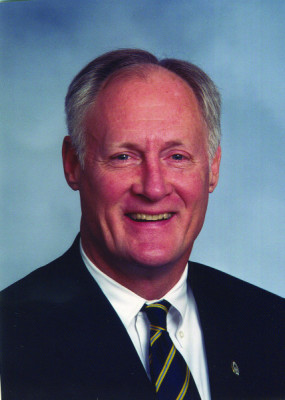
W. Dudley McCarter, a former president of The Missouri Bar, is a partner in the St. Louis law firm of Behr, McCarter, Neely & Gabris.
Amateur hockey player accepted risk of injury
Becker v. Schenk, 716 S.W.3d 350 (Mo. App. E.D. 2025).
Kyle Becker appealed the circuit court’s ruling on a claim of personal injury arising out of an ice hockey game. Becker argued the circuit court erred in finding he assumed the risk of breaking a bone while playing amateur ice hockey. The Missouri Court of Appeals- Eastern District affirmed the court’s judgment.1
A plaintiff claiming personal injury must prove:
1. the defendant had a duty to the plaintiff;
2. the defendant failed to perform that duty; and
3. the defendant’s breach was the proximate cause of the plaintiff’s injury.2
In personal injury cases arising out of athletic competitions, the Supreme Court of Missouri heightens the plaintiff’s burden of proof from negligence to recklessness.3 To show recklessness, the plaintiff must prove the defendant “deliberately or willfully engaged in conduct that demonstrated a reckless disregard for the plaintiff’s safety.”4 “In amateur contact sports … [o]rdinary negligence principles are inapplicable in such cases because ‘conduct which might be “unreasonable” in everyday society is not actionable because it occurs on the athletic field.’”5
 The risk agreement Becker signed “clearly and unambiguously” denoted the risk of “broken bones” as an injury resulting from “physical contact with other players … during the course of play[.]”6 By reading and signing the risk agreement, the Court of Appeals ruled, Becker “expressly assumed the risk of his precise injury.”7 “A broken bone is an inherent risk of ice hockey, a contact sport, Risk of injury, duty to third parties, and more known for rough play and for which injuries such as suffered by Plaintiff are reasonably anticipated,” the court noted.
“In contact sports, physical contact and injuries among participants [are] inherent and unwarranted judicial intervention might inhibit the game’s vigor,” the court added.8
Expert testimony on risk factors does not establish causation
McCostlin v. Monsanto Co., 718 S.W.3d 435 (Mo. App. E.D. 2025).
Mark McCostlin and his wife Karen McCostlin appealed the trial court’s ruling, arguing the court erred in granting a directed verdict in favor of Monsanto Company because the expert witnesses’ testimony established a submissible case on causation, which is an issue for the jury. The Missouri Court of Appeals-Eastern District affirmed the trial court’s verdict in McCostlin v. Monsanto Co.9
The McCostlins had to show a causal connection between the defendant’s product, Roundup, and Mark McCostlin’s injury, non-Hodgkin’s lymphoma.10
There is no dispute that to establish causation, the McCostlins needed to establish both general and specific cau[s]ation in order to make a submissible case … An action regarding liability for exposure to a toxic substance typically requires a certain degree of scientific expertise and the causal relationship must be established by expert testimony.11
The testimony of the McCostlins’ expert was that Mark McCostlin’s Roundup exposure was a “possible risk factor,” which is an “assurance of a possibility that is not sufficient to establish causation.”12 The Court of Appeals added:
[T]he trial court did not err in granting a directed verdict in favor of Monsanto because the McCostlins’ causation expert failed to demonstrate a causal connection between Monsanto’s products containing glyphosate (“Roundup”) and Mr. McCostlin’s non-Hodgkin’s Lymphoma.13
Psychiatrist owed no duty to third parties injured by patient
J.N. v. Anderson, ED113033 (Mo. App. E.D. 2025).
Ryne Dobson killed his stepfather, Kevin Nentwig. Dobson’s half-brother J.N. and his mother Colleen Nentwig later sued Dobson’s treating psychiatrist Dr. Dale Anderson for wrongful death based on medical negligence. The appellants claimed Anderson knew or should have known that Dobson presented a serious danger of future harm to Kevin Nentwig and failed to notify Dobson’s family of that danger, ultimately causing Kevin Nentwig’s death. The jury returned, and the Missouri Court of Appeals-Eastern District affirmed, a verdict for Anderson.14
The appellants claimed the trial court erred in failing to instruct the jury on an alternative theory of negligence in which the healthcare providers owe a duty to third parties to not prescribe medication that affirmatively cause patients to harm third parties.15 The appellants claimed Anderson had a duty to Dobson’s family to not prescribe medications that cause or contribute to causing Anderson’s patient to harm third parties, like Dobson’s stepfather.16
In a negligence action, the plaintiff “must establish the defendant owed a duty of care to the plaintiff, the defendant breached that duty, and the defendant’s breach proximately caused the plaintiff injury.”17 The standard for the creation of a duty is foreseeability18 which, “for purpose of determining if a duty exists, is defined as the presence of some probability or likelihood of harm sufficiently serious that ordinary persons would take precautions to avoid it.”19 The possibility of harm is not sufficient enough to establish foreseeability.20 
Based on this, the Court of Appeals stated it was “not persuaded to recognize such a duty because the record here does not establish that Decedent’s death was reasonably foreseeable.”
The health and safety of a foreseeable victim, such as an immediate family member the patient makes explicit threats about, is certainly an interest worthy of protection. But that must be balanced with the public’s interest in maintaining the physician-patient privilege.21
Admission of demonstrative evidence used by expert was not error
Richardson v. Hawes, 725 S.W.3d 301 (Mo. App. S.D. 2025).
Julia Richardson filed a lawsuit against Dr. Arthur Hawes and Ferrell-Duncan Clinic, Inc., alleging medical negligence in connection with a rhytidectomy and an abdominoplasty. A jury found in favor of the defendant, and on appeal, Richardson argued the trial court erred in admitting demonstrative exhibits during the defendants’ direct examination of their expert. The Missouri Court of Appeals-Southern District affirmed the judgment.22
A trial court has broad discretion in admitting or excluding evidence.23 “Even when an evidentiary ruling is in error, this Court will not set aside the jury’s verdict unless that error likely changed the outcome of the case.”24 To demonstrate error in the admission of demonstrative evidence, an appellant must show an abuse of discretion by the trial court that results in prejudice to the appellant.25
The Richardson trial court admitted the exhibits as demonstrative aids to help explain the testimony of the defendants’ expert. The appellate court found that despite Richardson’s hearsay objection, Richardson did not request a limiting instruction to the jury to ignore any hearsay in the exhibits.26
The Court of Appeals further found that Richardson’s foundational contention on appeal challenging the defendants’ compliance with § 490.065, which states expert opinion must be based on information considered reasonably reliable in the subject field, was not raised at trial.
Assuming arguendo that the trial court erred, our decision would not change because Richardson has failed to demonstrate how she was prejudiced … We fail to see how the outcome of the trial would have been different absent Defendants’ use of the subject exhibits, especially in light of the jury’s unanimous verdict in favor of Defendants.27
Endnotes
1 Becker v. Schenk, 716 S.W.3d 350 (Mo. App. E.D. 2025).
2 State ex rel. Tyler Techs., Inc. v. Chamberlain, 679 S.W.3d 474, 477 (Mo. banc 2023) (internal quotation omitted).
3 See Ross v. Clouser, 637 S.W.2d 11, 13-14 (Mo. banc 1982).
4 Becker, 716 S.W.3d at 357 (citing McKichan v. St. Louis Hockey Club, L.P., 967 S.W.2d 209, 211 (Mo. App. E.D. 1998)).
5 Elias v. Davis, 535 S.W.3d 737, 744-45 (Mo. App. W.D. 2017) (quoting McKichan, 967 S.W.2d at 211-12).
6 Becker, 716 S.W.3d at 360.
7 Id. (citing Ferbet v. Hidden Valley Golf and Ski, Inc., 618 S.W.3d 596, 606 (Mo. App. E.D. 2020)).
8 McKichan, 967 S.W.2d at 212.
9 718 S.W.3d at 435 (Mo. App. E.D. 2025).
10 Poage v. Crane Co., 523 S.W.3d 496, 508 (Mo. App. E.D. 2017).
11 McCostlin, 718 S.W.3d at 442. See also Brown for Est. of Kruse v. Seven Trails Invs., LLC, 456 S.W.3d 864, 869-70 (Mo. App. E.D. 2014).
12 Id. at 443; See also Linton by and through Linton v. Carter, 634 S.W.3d 623, 629 (Mo. banc 2021) (“[A] plaintiff bears the burden of proving causation, ‘[a]ssurance of possibility is not of itself … sufficient to make a submissible case.’”)
13 Id. at 440.
14 J.N. v. Anderson, ED113033 (Mo. App. E.D. 2025).
15 Id.
16 Id.
17 Weiland v. Owner-Operator Servs., Inc., 540 S.W.3d 845, 848 (Mo. banc 2018).
18 Id.
19 Reddick v. Spring Lake Estates Homeowner’s Association, 648 S.W.3d 765, 781 (Mo. App. E.D. 2022) (internal citations omitted).
20 Id.
21 J.N., ED113033 at 8 (citing Virgin v. Hopewell Center, 66 S.W.3d 21, 27 (Mo. App. E.D. 2001)).
22 Richardson v. Hawes, 725 S.W.3d 301 (Mo. App. S.D. 2025).
23 Moore v. Ford Motor Co., 332 S.W.3d 749, 756 (Mo. banc 2011).
24 Barkley v. McKeever Enters., Inc., 456 S.W.3d 829, 842 (Mo. banc 2015).
25 Feiteira v. Clark Equip. Co., 236 S.W.3d 54, 63 (Mo. App. 2007).
26 Richardson, 725 S.W.3d at 307.
27 Id. at 308-309.