


The flag: Solar panels, defamation claim, and more
Vol. 82, No. 5 / September-October 2026
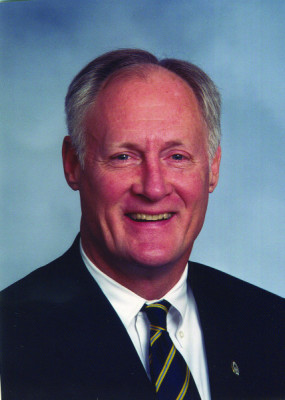
W. Dudley McCarter, a former president of The Missouri Bar, is of counsel with the firm of McCarthy, Leonard, Kaemmerer and Miller.
Homeowners association cannot prohibit solar panels
Eikmeier v. Granite Springs Home Owners Association, Inc., 727 S.W.3d 432 (Mo. banc 2026).
Homeowners Colleen Eikmeier and William Love purchased a lot in a subdivision subject to covenants banning solar panels. Shortly after, the Missouri General Assembly enacted § 442.404.3 proscribing any covenant from limiting or prohibiting installation of solar panels. The circuit court denied the homeowners’ injunctive relief, stating the statute could not apply to preexisting covenants. However, the Supreme Court of Missouri reversed the decision.1
“[S]tatutes are presumed to operate prospectively”2 unless “the legislative intent that they be given retroactive operation clearly appears from the express language of the act or by necessary or unavoidable implication.”3 If the statute can operate retroactively, it can “look or act backward from its effective date.”4 The Supreme Court of Missouri found, “based on the express language of the statute, the legislature intended broad applicability, extending to those covenants already in existence.”5
 The homeowners argued Missouri’s public policy encourages solar energy usage,6 and solar energy is a recognized property right in the state.7 Considering this, the homeowners added the four-month delay before the statute’s enactment “could not have served any purpose other than to permit homeowners’ associations to (1) remove covenants limiting or prohibiting the installation of solar panels and/or (2) adopt the rules envisioned by section 442.404.3(2).” The Court agreed, stating § 442.404.3 “did not remove oversight from homeowners’ associations and their legitimate interest in harmonizing improvements within subdivisions. The statute removes the ability to impose merely one prohibition.”8
The circuit court erred in finding section 442.404.3 applies solely to newly created homeowners’ associations filing covenants after the statute’s effective date. Section 442.404.3 applies to all covenants, including those in existence before the statute’s effective date.9
Missouri Human Rights Act does not cover acts outside
Missouri Sciortino v. Ozark Nat’l Life Ins. Co., 726 S.W.3d 755 (Mo. App. W.D. 2025).
Carrie Sciortino appealed the circuit court’s judgment dismissing her lawsuit asserting claims for relief under the Missouri Human Rights Act against employer Ozark National Life Insurance Company. The Missouri Court of Appeals, Western District, affirmed the dismissal.10
The MHRA requires a person be “aggrieved by an unlawful discriminatory practice” before filing a complaint with the MHRA.11 While “aggrieved” is not defined by the MHRA, the Supreme Court of Missouri found that a plaintiff must have suffered an adverse impact from an unlawful discriminatory practice while physically present in Missouri before they can bring an actionable claim under the MHRA.12 That logic is due to “the longstanding presumption that Missouri statutes, absent express text to the contrary, apply only within the boundaries of this state and have no extraterritorial effect.”13
In this case, the court found that Sciortino “failed to plead facts in her amended petition that entitle her to relief under the MHRA,” because Sciortino may have been aggrieved in Louisiana, not Missouri.14
Property owner has no duty to clear sidewalks from ice and snow accumulated from general weather conditions
Brandes v. Bothwell Reg’l Health Ctr., 725 S.W.3d 283 (Mo. App. W.D. 2025).
Larry Brandes appealed the trial court’s summary judgment in favor of Bothwell Regional Health Center on his claim that Bothwell was negligent in failing to clear the ice and snow from its sidewalk that Brandes slipped on. The Missouri Court of Appeals, Western District, affirmed the judgment.15
To prevail on a claim of negligence based on premises liability, “the plaintiff must establish that the defendant had a duty to protect the plaintiff from injury, the defendant failed to perform that duty, and the defendant’s failure proximately caused injury to the plaintiff.”16 Generally, whoever possesses the land owes an invitee the duty to make the property safe from known dangers and dangers that should have been known.17 However, under the Massachusetts Rule, “an invitor has no duty to remove snow or ice on outside areas where the snow or ice accumulated naturally as a result of general weather conditions within the community.”18 The Massachusetts Rule is
reasonable[,] for where the condition is one general to the community it creates a natural hazard to everyone who ventures out at such time. The condition is brought about by no one and no one’s efforts can appreciably lessen the danger present.19
The Massachusetts Rule does not negate a duty owed, however, “where one is obligated to remove snow and ice either by agreement or a course of conduct over a period of time.”20
The Missouri Court of Appeals found:
[I]n the absence of actual alteration of the snow or ice on the sidewalk before Brandes fell, the “course of conduct” exception to the Massachusetts Rule is not established. At best,the controverted facts Brandes has highlighted establish that Bothwell had general snow removal policies. However, “[t]he existence of a snow removal policy alone does not create a duty to remove snow or ice.”21
Public figure must show actual malice to prevail on defamation claim
Allsberry v. Flynn, 730 S.W.3d 271 (Mo. App. E.D. 2026).
Circuit Clerk Karla Allsberry filed a lawsuit against Hon. Patrick Flynn for defamation and other claims. The trial court granted summary judgment to Flynn, and the Missouri Court of Appeals, Eastern District, affirmed the judgment.22
 Defamation law protects an individual against harm to their reputation.23 To prevail on a defamation claim, “the plaintiff must prove that, with the requisite degree of fault, the defendant published a false and defamatory statement identifying the plaintiff, which damaged the plaintiff’s reputation.”24 The requisite degree of fault for a public figure like Allsberry is actual malice.25
“Despite the ordinary understanding of the word ‘malice,’ in the defamation context, ‘[a]ctual malice’ is not about whether [the defendant] had ill will toward [the plaintiff]”26 or that the defendant “acted out of spite, or to injure the plaintiff, or because of animosity.”27 Rather, actual malice occurs when “a defendant had actual knowledge that the alleged defamatory statement was false or acted with reckless disregard as to its truth or falsity at a time when the defendant had serious doubts as to its truth.”28
The Court of Appeals noted that proof of falsity does not equal proof of malice,29 so Allsberry’s “repeated insistence that the statements [made by Flynn] were untrue is misplaced as it does not show that Flynn … knew the statements were false.”30
Even if there was evidence that Flynn’s … conduct in making the defamatory statements was indecent, atrocious, and intolerable, that would not necessarily be probative of whether [he] had actual knowledge that the statements were false when [he] made them.
Finally, to the extent that Flynn … harbored ill-will or animosity toward Allsberry, wanted to harm her reputation, or acted out of spite, those sentiments do not, without more, establish the element of actual malice in a defamation claim.31
Endnotes
1 Eikmeier v. Granite Springs Home Owners Association, Inc., 727 S.W.3d 432 (Mo. banc 2026).
2 Cedar Cnty. Comm’n v. Parson, 661 S.W.3d 766, 774 (Mo. banc 2023).
3 Lincoln Credit Co. v. Peach, 636 S.W.2d 31, 34 (Mo. banc 1982).
4 Cedar Cnty. Comm’n, 661 S.W.3d at 774 (brackets removed from quote).
5 Eikmeier, 727 S.W.3d at 438.
6 Id.
7 Mo. Rev. Stat. § 442.012.1.
8 Eikmeier, 727 S.W.3d at 441.
9 Id. at 442.
10 Sciortino v. Ozark Nat’l Life Ins. Co., 726 S.W.3d 755 (Mo. App. 2025).
11 Tuttle v. Dobbs Tire & Auto Ctrs., Inc., 590 S.W.3d 307, 310 (Mo. banc 2019) (citing §§ 213.075.1, 213.111.1 (2016)).
12 Id. at 310-11.
13 Tuttle, 590 S.W.3d at 311 (citing Rostizky v. Rostizky, 46 S.W.2d 591, 595 (Mo. 1931); Stanley v. Wabash St. L. Ry. Co., 13 S.W. 709, 710 (Mo. 1890)).
14 Sciortino, 726 S.W.3d at 761.
15 Brandes v. Bothwell Reg’l Health Ctr., 725 S.W.3d 283 (Mo. App. W.D. 2025).
16 A.R.R. v. Tau Kappa Epsilon Fraternity, Inc., 649 S.W.3d 1, 8 (Mo. App. W.D. 2022) (quoting L.A.C. ex rel. D.C. v. Ward Parkway Shopping Ctr. Co., 75 S.W.3d 247, 257 (Mo. banc 2002)).
17 Ford v. Ford Motor Co., 585 S.W.3d 317, 332 (Mo. App. W.D. 2019).
18 Medlock v. St. John Health Sys., Inc., 426 S.W.3d 35, 38 (Mo. App. S.D. 2014) (quoting Willis v. Springfield Gen. Osteopathic Hosp., 804 S.W.2d 416, 419 (Mo. App. S.D. 1991)).
19 Woodley v. Bush, 272 S.W.2d 833, 835 (Mo. App. 1954).
20 Medlock, 426 S.W.3d at 38 (citing Willis, 804 S.W.2d at 419).
21 Brandes, 725 S.W.3d at 300 (quoting Medlock, 426 S.W.3d at 39 n.5).
22 Allsberry v. Flynn, 730 S.W.3d 271 (Mo. App. E.D. 2026).
23 Smith v. Humane Soc’y of United States, 519 S.W.3d 789, 798 (Mo. banc 2017).
24 Id.
25 Bauer v. 7-Eleven, Inc., 391 S.W.3d 25, 28 (Mo. App. E.D. 2012).
26 Allsberry, 730 S.W.3d at 279 (quoting Bugg v. Vanhooser Holsen & Eftink P.C., 152 S.W.3d 373, 377 (Mo. App. W.D. 2004) (emphasis added)).
27 Smith v. UAW-CIO Fed. Credit Union, 728 S.W.2d 679, 683 (Mo. App. W.D. 1987); Wright v. Over-The-Rd. & City Transfer Drivers, Helpers, Dockmen & Warehousemen, Loc. Union No. 41, 945 S.W.2d 481, 497 (Mo. App. W.D. 1997).
28 Bauer, 391 S.W.3d at 28.
29 Westhouse v. Biondo, 990 S.W.2d 68, 72 (Mo. App. E.D. 1999).
30 Allsberry, 730 S.W.3d at 280.
31 Id.; See Bugg, 152 S.W.3d at 377; Smith, 728 S.W.2d at 683; Wright, 945 S.W.2d at 497.