


The Flag: Evidence of car race, right to intervene, more
Vol. 81, No. 4 / July-August 2025
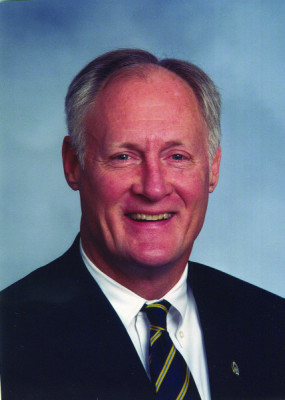
Compiled by W. Dudley McCarter, former president of The Missouri Bar and partner in the St. Louis law firm of Behr, McCarter, Neely & Gabris.
INSURER HAD RIGHT TO INTERVENE IN WRONGFUL DEATH LAWSUIT TO SEEK STAY UNTIL COVERAGE ISSUES WERE RESOLVED
McCrackin v. Mullen, 701 S.W.3d 868 (Mo. banc 2024).
Safeco Insurance Company of America sought intervention to seek a stay in a wrongful death action until a separate declaratory judgment action filed in federal court could be resolved. The circuit court overruled Safeco’s motion to intervene, but the Supreme Court of Missouri vacated the court’s judgment and remanded the case for further proceedings.1
The Missouri Court of Appeals-Southern District first recognized the intervention-and-stay procedure in State ex rel. Mid-Century Insurance Co. v. McKelvey,2 which found that insurers with coverage questions could seek intervention in an underlying tort action for the sole purpose of seeking a stay of the tort proceedings while coverage questions were litigated in a separate declaratory judgment action.3 "For the past 40 years, insurers have relied on such instruction, and the court of appeals has consistently echoed the principle set in McKelvey.”4
Rule 52.12(a) should be construed liberally to permit broad intervention. For these reasons, insurers situated like Safeco have an interest in protecting their right to defend the underlying tort action pursuant to Rule 52.12(a) (2), which creates the right to intervene for the limited purpose of seeking a stay in a tort action while coverage questions are litigated in a separate declaratory judgment action.5
The Supreme Court of Missouri added:
Insurers with good faith coverage questions should file a declaratory judgment action simultaneous with the underlying tort action and seek a stay of the tort action until the declaratory judgment action is resolved. Because Safeco met the criteria for intervention pursuant to Rule 52.12(a)(2), the circuit court erred in overruling Safeco’s motion to intervene.6
EVIDENCE OF CAR RACE PRIOR TO COLLISION WAS PREJUDICIAL
Childers v. Williams, 700 S.W.3d 317 (Mo. App. E.D. 2024).
Clayton Childers was involved in and placed a bet on a motor vehicle race. Following the race, Childers was involved in a vehicular collision on a different road. Childers argued the trial court erred in admitting evidence of his involvement in the race because it was unconnected to the collision. The Missouri Court of Appeals-Eastern District held that the admission of any evidence Childers was in a race prior to the collision was prejudicial. The appellate court reversed the judgement and remanded for a new trial.7 
Evidence must be logically and legally relevant to be admissible.8 Evidence is logically relevant if it “tends to make the existence of any fact that is of consequence to the determination of the action more probable or less probable than it would be without the evidence.”9 ”Determining legal relevance requires the trial court to balance the probative value of the proffered evidence against its prejudicial effect on the jury.”10
To be legally relevant, evidence of a driver’s speed prior to a collision “must be ‘connected’ with the collision in such a way that the conduct of the driver may be said to be continuous.”11 Accordingly, ”the only relevant evidence of speed is the speed immediately before the collision.”12
The evidence that Childers engaged in a race was not relevant as it was an isolated event unconnected to the collision. Moreover, even if Childers had requested the testimony be stricken or requested an instruction, the proverbial bell had been rung and the prejudicial damage was done. This Court holds the evidence alluding to the race should not have been admitted because it was not relevant and "was so inflammatory and prejudicial that a new trial” is warranted.13
PUNITIVE DAMAGES UPHELD AGAINST HOTEL FOR ASSAULT OF GUEST
Dugan v. Hyatt Corp., 707 S.W.3d 669 (Mo. App. E.D. 2024).
On April 19, 2016, at the Hyatt Regency hotel in downtown St. Louis, Hyatt security guard D.W. used his master key to sneak into respondent Shannon Dugan’s hotel room to sexually assault her while she slept. In her petition against Hyatt, Dugan brought claims for negligent hiring of D.W., negligent supervision of D.W., and negligent training and supervision of Hyatt security employees, which she claimed led to the assault. Hyatt appealed the judgment entered on the jury’s verdict in favor of Dugan in the amount of $28 million in compensatory damages and $149 million in punitive damages. The Missouri Court of Appeals-Eastern District affirmed the judgment.14
 Hotel operators and their guests have a relationship “so as to impose affirmative duties in the protection of persons and property.”15 ”This duty encompasses more than the duty normally owed by a business to an invitee. This is because guests entrust themselves to the protection of innkeepers and [rely] upon them to provide a place of safety.”16
Punitive damages not only inflict punishment, but also serve as an example and a deterrent to similar conduct.17 To recover punitive damages in a negligence action, “the plaintiff must demonstrate that the defendant showed a complete indifference to or conscious disregard for the safety of others” through clear and convincing evidence.18 In determining whether a plaintiff has met their burden, a court must consider ”whether the evidence … is sufficient to permit a reasonable juror to conclude that the plaintiff established with convincing clarity … that the defendant’s conduct was outrageous because of evil motive or reckless indifference.”19
The Missouri Court of Appeals stated the evidence supports the submission of punitive damages on these claims.20 The jury heard evidence regarding how Hyatt did not fully cooperate and even interfered with the police investigation.21 "Our courts have routinely upheld punitive awards based on cover-up activities that occurred after the conduct causing the underlying harm.”22
Hyatt’s conduct in this regard epitomizes a conscious disregard for the rights and interest[s] of its own hotel guest who suffered a sexual assault in her hotel room at the hands of Hyatt’s own security guard. Instead of following its policies and putting Dugan’s interest[s] first, the jury appears to have concluded that Hyatt, from the top of its corporate governance, prioritized its own interests. This evidence supports the conclusion that the trial court properly submitted punitive damages to the jury.23
WHEN FRAUD CLAIM IS BASED ON STATEMENT OF INTENT, DETERMINATION OF INTENT IS FOR JURY
Niemeier v. Williams, 707 S.W.3d 779 (Mo. App. E.D. 2025).
Russell Williams III appealed the circuit court’s judgment in Andrew Niemeier’s favor on fraudulent misrepresentation claims. The Missouri Court of Appeals-Eastern District affirmed the judgment.24
To [prove] liability for fraudulent misrepresentation, a party must demonstrate: (1) a representation; (2) its falsity; (3) its materiality; (4) the speaker’s knowledge of its falsity or ignorance of its truth; (5) the speaker’s intent that it should be acted on by the person in the manner reasonably contemplated; (6) the hearer’s ignorance of the falsity of [the] representation; (7) the hearer’s reliance on the representation being true; (8) the hearer’s right to rely thereon; and (9) the hearer’s consequent and proximately caused injury.25
“To constitute fraud, the alleged misrepresentation must relate to a past or existing fact.”26 ”A statement of opinion, expectation, or [a] future prediction is insufficient for fraudulent misrepresentation recovery because that statement necessarily is indefinite and uncertain.”27
Williams’ representation that Niemeier would be 50% owner "was not an opinion, expectation, or a future prediction. This was a fact that could be readily identified; determination of Niemeier’s interest did not depend on a future contingency.”28
"When a fraud claim is based on a statement of intent, the plaintiff establishes falsity by showing that when the statement was made, the speaker did not intend to perform consistently with the statement.”29 Merely failing to perform does not establish intent.30
The Missouri Court of Appeals found there was sufficient evidence for the jury to believe that Williams offered Niemeier 50% ownership in Green Park, Niemeier acted based upon that representation, and Williams did not intend for Niemeier to become a 50% owner.31
Endnotes:
1 McCrackin v. Mullen, 701 S.W.3d 868 (Mo. banc 2024).
2 666 S.W.2d 457, 459 (Mo. App. 1984).
3 Id. at 459.
4 McCrackin, 701 S.W.3d at 875.
5 Id. at 876 (citing Maries Cnty. Bank v. Hoertel, 941 S.W.2d 806, 810 (Mo. App. 1997)).
6 Id.
7 Childers v. Williams, 700 S.W.3d 317 (Mo. App. E.D. 2024).
8 Hurley v. Burton, 626 S.W.3d 810, 825 (Mo. App. E.D. 2021).
9 Id. (citation omitted)
10 Koon v. Walden, 539 S.W.3d 752, 761 (Mo. App. E.D. 2017).
11 Stapleton v. Griewe, 602 S.W.2d 810, 814 (Mo. W.D. 1980).
12 Mott v. Missouri Pac. R.R. Co., 926 S.W.2d 81, 85 (Mo. App. W.D. 1996).
13 Childers, 700 S.W.3d at 320 (internal citations omitted); See Stapleton, 602 S.W.2d at 814; Wehrkamp v. Watkins Motor Lines, 436 S.W.2d 698, 709-11 (Mo. 1969).
14 Dugan v. Hyatt Corp., 707 S.W.3d 669 (Mo. App. E.D. 2024).
15 Virginia D. v. Madesco Corp., 648 S.W.2d 881, 886-87 (Mo. banc 1983).
16 Dugan, 707 S.W.3d at 684 (citing Virginia, 648 S.W.2d at 886; Garrett v. Impac Hotels, L.L.C., 87 S.W.3d 870, 873 (Mo. App. E.D. 2002)).
17 Call v. Heard, 925 S.W.2d 840, 849 (Mo. banc 1997).
18 Ingham v. Johnson & Johnson, 608 S.W.3d 663, 714 (Mo. App. E.D. 2020) (quoting Poage v. Crane Co., 523 S.W.3d 496, 515 (Mo. App. E.D. 2017)).
19 Id. at 715 (quoting Peters v. Gen. Motors Corp., 200 S.W.3d 1, 25 (Mo. App. W.D. 2006)).
20 Dugan, 707 S.W.3d.
21 Id. at 688.
22 DeLaRosa v. Farmers State Bank S/B, 474 S.W.3d 240, 247 (Mo. App. W.D. 2015).
23 Dugan, 707 S.W.3d. at 689 (citing DeLaRosa, 474 S.W.3d at 247).
24 Niemeier v. Williams, 707 S.W.3d 779 (Mo. App. E.D. 2025).
25 Stevens v. Markirk Constr., Inc., 454 S.W.3d 875, 880 (Mo. banc 2015) (quoting Renaissance Leasing, LLC v. Vermeer Mfg. Co., 322 S.W.3d 112, 131-32 (Mo. banc 2010)).
26 Trotter’s Corp. v. Ringleader Restaurants, Inc., 929 S.W.2d 935, 940 (Mo. App. 1996).
27 Niemeier, 707 S.W.3d at 786 (citing Dancin Dev., LLC v. NRT Mo., Inc., 291 S.W.3d 739, 744 (Mo. App. 2009)).
28 Id.
29 Renaissance Leasing, 322 S.W.3d at 133.
30 Id.
31 Niemeier, 707 S.W.3d at 787.