


The flag: Partition of property, abuse of discretion involving drug usage, and more
Vol. 82, No. 2 / March-April 2026
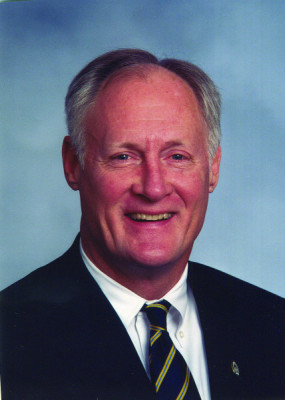
W. Dudley McCarter, a former president of The Missouri Bar, is a partner in the St. Louis law firm of Behr, McCarter, Neely & Gabris.
Court did not err in partitioning property among siblings
Blaylock v. Blaylock, 715 S.W.3d 206 (Mo. App. W.D. 2025).
Plaintiffs Thomas and Martha Blaylock appealed the circuit court’s judgment partitioning in-kind real property that Thomas Blaylock and his three siblings, the defendants, inherited from their mother’s estate. The Blaylocks argued that dividing the property in kind instead of ordering that all the property be sold and the proceeds be distributed resulted in “great prejudice to them.”1 The Missouri Court of Appeals-Western District affirmed the circuit court’s judgment.2
Under Supreme Court of Missouri Rule 96.08, it is up to the court to determine the parties’ interests and order partition in kind or by sale of the land. Courts generally favor a partition in kind over partition by sale “unless it would result in great prejudice to the owners.”3 To decide whether a great prejudice would exist, the courts must determine “whether or not the value of the share of each, after partition, would be materially less than the share of the money equivalent that each could probably obtain from the whole.”4
The Court of Appeals ruled:
The evidence shows the court carefully considered the physical characteristics of the property and the differences in value in determining that partition in kind, with an owelty awarded to Plaintiffs, was appropriate and would not result in great prejudice to the parties.5
Evidence of cocaine use was not abuse of discretion
Midwest Tr. Co. v. United Parcel Serv., Nos. WD86697, WD87624 (Mo. App. W.D. 2025).
 Following a jury trial, the United Parcel Service, Inc. appealed a judgment awarding compensatory damages on a negligence claim for in utero injuries to K.P., who sustained fetal brain damage in a car wreck involving a UPS delivery truck driven by Steven Miller.6 K.P. was born with severe neurological impairments seven months after the wreck.7 UPS argued the circuit court erred in admitting evidence of Miller’s history of cocaine use. The Missouri Court of Appeals-Western District affirmed the judgment.8
UPS accepted responsibility for Miller causing the car wreck while driving a company vehicle.9 At trial, UPS objected to evidence of Miller’s history of cocaine use as “irrelevant and highly prejudicial” because (1) UPS had admitted responsibility for Miller’s conduct, and (2) there was no “credible evidence” that he was under the influence of drugs at the time of the wreck.10
Under the general rule of McHaffie v. Bunch,11 UPS argued that once it accepted respondeat superior liability, Midwest Trust Co., the conservator and next of friend of K.P., could not pursue any other claims of imputed negligence for Miller’s conduct. However, McHaffie recognized an exception to the general rule in cases where the employer may be liable for punitive damages that would not be assessed against the employee.12
Midwest asserted claims for punitive damages that fell within that exception, and therefore the circuit court allowed submission of the additional claim for negligent entrustment of the UPS vehicle and evidence that would support a punitive damages award based on Miller’s drug use.13
The jury found that drug use was not a factor in the wreck and denied relief for alleged misconduct under the negligent entrustment and punitive damages claims.14 The Court of Appeals later ruled, “The circuit court did not abuse its discretion in admitting the evidence as it was logically and legally relevant to the negligent entrustment and punitive damage claims, regardless of the jury’s ultimate decision.”15
Trial court did not err in applying multiplier to attorneys’ fees
Petifurd v. Mo. Dep’t of Corr., No. WD87416 (Mo. App. W.D. 2025).
The Missouri Department of Corrections appealed the judgment in favor of former employee Danny Petifurd on his claim of retaliation under the Missouri Human Rights Act. The DOC argued the trial court erred by applying a 1.5 multiplier to calculate attorneys’ fees awarded to Petifurd. The Missouri Court of Appeals-Western District affirmed the ruling.16
The DOC claimed the trial court erred by applying a 1.5 multiplier because the court considered the contingent nature of the case when determining the lodestar amount and again when evaluating the necessity of applying a multiplier.
The trial court has discretion to award reasonable attorneys’ fees, but there are factors that it may consider to determine the amount, including:
1) the rates customarily charged by the attorneys involved in the case and by other attorneys in the community for similar services; 2) the number of hours reasonably expended on the litigation; 3) the nature and character of the services rendered; 4) the degree of professional ability required; 5) the nature and importance of the subject matter; 6) the amount involved or the result obtained; and 7) the vigor of the opposition.17
The Missouri Court of Appeals-Western District ruled:
Even if the trial court did duplicate its consideration of the contingent nature of the representation, we decline to find that the court abused its discretion in applying a 1.5 multiplier to the lodestar amount where other non-duplicative factors supported use of the multiplier.18
Expert testimony unnecessary in private nuisance action
Neighborhood Legal Support of Kansas City v. Ontman, 717 S.W.3d 600 (Mo. App. W.D. 2025).
Robert Ontman appealed the judgment in favor of Neighborhood Legal Support of Kansas City’s claim requiring Ontman to take actions to abate a nuisance. Otman claimed (1) NLS lacked standing to bring its nuisance suit and (2) nonexpert opinion testimony should not have been allowed in the case.19
Under § 82.1025.2, RSMo, any person or entity who owns property within 1,200 feet of the alleged nuisance property can file a civil nuisance action. The trial court found that since NLS owns property within 1,200 feet of Ontman’s property, it had standing to bring the suit.20
Ontman also argued the trial court erroneously allowed nonexpert opinion testimony regarding the property’s nuisance conditions, asserting that only an expert’s testimony can establish a nuisance condition. The Missouri Court of Appeals-Western District disagreed, stating the code violations documented in NLS’ photographs are “so glaring and obvious that a person without any specialized training can readily identify them by looking at the photos, rendering expert testimony unnecessary in this particular case.”21
The Court of Appeals affirmed the judgment, noting:
The trial court did not err in allowing lay witnesses to testify regarding the clear and unmistakable code violations depicted by the photographs, which constituted sufficient evidence to support the trial court’s conclusion that the property qualified as the sort of nuisance contemplated by section 82.1025.
Endnotes
1 Blaylock v. Blaylock, 715 S.W.3d 206, 1 (Mo. App. W.D. 2025).
2 Id.
3 Von Behren v. Oberg, 902 S.W.2d 338, 340 (Mo. App. 1995).
4 Id.
5 Blaylock, 715 S.W.3d at 11-12.
6 Midwest Tr. Co. v. United Parcel Serv., Nos. WD86697, WD87624 (Mo. App. W.D. 2025).
7 Id.
8 Id.
9 Id.
10 Id. at 3.
11 891 S.W.2d 822, 825 (Mo. banc 1995).
12 Id. at 826.
13 Midwest, Nos. WD86697, WD87624 at 7. See also Wilson v. Image Flooring, LLC, 400 S.W.3d 386, 393 (Mo. App. 2013).
14 Midwest, Nos. WD86697, WD87624 at 9.
15 Id.
16 Petifurd v. Mo. Dep’t of Corr., No WD87416 (Mo. App. W.D. 2025).
17 Berry v. Volkswagen Grp. of Am., 397 S.W.3d 425, 431 (Mo. banc 2013).
18 Petifurd, No. WD87416 at 19.
19 Neighborhood Legal Support of Kansas City v. Ontman, 717 S.W.3d 600 (Mo. App. W.D. 2025).
20 Id.
21 Id.; See also Stone v. Mo. Dep’t of Health & Senior Servs., 350 S.W.3d 14, 22 (Mo. banc 2011) (“If the fact at issue is ‘open to the senses,’ the option of [a] lay witness is admissible.” (quoting Beuttenmuller v. Vess Bottling Co. of St. Louis, 447 S.W.2d 519, 526 (Mo. 1969))).