


Write a contract your client can understand
Vol. 81, No. 2 / March-April 2025
Alan Freed has devoted his career to the practice of family law, as a trial and appellate lawyer, mediator, collaborative practitioner, and teacher. Freed has been listed in Best Lawyers in various family law-related areas of practice since 2007 and has been named a St. Louis “Lawyer of the Year” by Best Lawyers in his practice areas seven times since 2013. In 2016, Freed received the Roger P. Krumm Family Law Award from The Missouri Bar. Freed is a co-author (with Alisse Camazine) of the book “Divorce in Mis souri” and is one of a handful of leading collaborative practitioners asked to contribute to “Understanding Collaborative Family Law.” He is also the co-author (with Daniel P. Card, II) of “Appellate Practice, Volume 24” in the “West Publishing Missouri Practice” series. Freed is a 1983 graduate of the Washington University School of Law and has practiced with the Clayton firm Paule, Camazine & Blumenthal, P.C., since the firm’s founding in 1994.
Ask the average person how lawyers differ from their neighbors and one answer you’re likely to hear is, “They speak a different language — legalese.” Sadly, that perception is not wrong.
In contrast to other professions, lawyers tend to cling to the language of the past with a seemingly unshakeable tenacity. This includes contracts that announce themselves with “WITNESSETH,” references to “the said minor child,” and the dreaded “here” family (herein, hereinabove, heretofore, hereby, etc.). There are dozens of examples of archaic, outdated words and phrases that lawyers use, erecting barriers to comprehension and unnecessarily requiring clients to ask what documents mean.
How is it that these words from the distant past persist, and what can lawyers do to break the mold and give clients separation agreements, sales contracts, leases, trusts, pleadings, and a host of other documents written in language they can readily understand?
How and why
First — the how and why. My own theory, based on personal experience and nods of recognition when I’ve outlined it to other lawyers, has to do with our first experiences as “baby lawyers.”
Law school graduates possess lots of knowledge about the law of contracts, torts, trusts and estates, property, and other substantive areas. They have learned how to read cases and statutes and how to find the law. Frequently, however, they have little knowledge about how our profession is practiced in the real world.
When my first employer asked me to draft a PDL motion (a motion pendente lite for temporary orders in a family law case), I had no clue where to begin. Recognizing my confused look, he quickly found an example and handed it to me. “COMES NOW, THE PETITIONER,” it began, so I duly inserted the relevant information from the case I was assigned into the old motion. That document became my template for future motions. And since the motion closed with, “WHEREFORE, Petitioner prays,” that phrase appeared at the end of every pleading I drafted. “That’s the way it’s done,” I thought to myself.
It doesn’t take a great deal of imagination to visualize the same scene occurring when my boss began his life as a lawyer and his first employer similarly handed him examples to rely upon for drafting pleadings, contracts, and other legal documents.
Another likely contributor to outdated writing style is a lawyer’s fear of risking a bad outcome from using untested language. Some lawyers may think, “If it was good enough for other lawyers, it’s good enough for me,” or, “It’s what the judge expects.”
So, if a lawyer in 1940 wrote a contract stating, “NOW, THEREFORE, in consideration of the mutual promises and other good and valuable consideration herein expressed, the sufficiency of which is hereby acknowledged, the parties hereto agree as follows,” modern lawyers may fear that changing that lingo will jeopardize the contract’s effectiveness. 
Write how you speak
In “Legal Writing in Plain English,” Bryan Garner, editor of “Black’s Law Dictionary,” offers lawyers a simple suggestion: “If you wouldn’t say it, don’t write it.”
Consider giving those outdated templates a much-needed refresh. Read them carefully and consider whether the average person would understand the language. If you, a highly trained professional, are struggling with any of the words or the convoluted syntax, your clients may have trouble making sense of the document.
Constantly ask, “What does this word or phrase add to the document?” If the only answer is “Because it’s always been there,” take it out. Once you’ve decided you need to make changes, where should you begin? Here are a few suggestions for streamlining your documents so clients can understand them:
Assume document will be attacked by that lawyer
You know the one — the lawyer who twists words in a sufficiently plausible way that you will have to respond, and your client will have to pay you while you try to convince a judge that your words meant what you intended them to mean. If you start with simple, modern language and sentences, you are setting yourself (and your client) up for success from the beginning.
Jettison the jargon
No statute or rule requires pleadings to open with “Comes now…” Get rid of the formulaic language and replace it with the simplest possible version. Instead of, “Petitioner, by and through counsel, for her Petition for Dissolution of Marriage, states and avers as follows,” change it to, “Petitioner, for her petition for dissolution of marriage, states:,” for example.
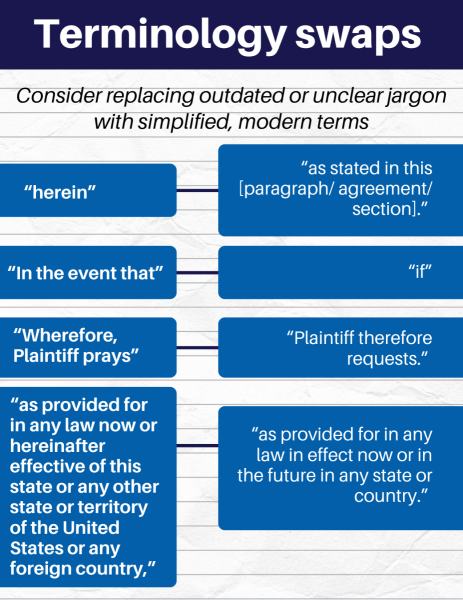
One easy change that will immediately make documents clearer is to give “herein” the heave-ho. Every time a contract refers to a proposition “stated herein,” I ask the question, “In what?” Does that mean in this paragraph? In this section? In this document? In the pending action? While in most instances, the answer will be clear from context, lawyers can eliminate all possibility of misinterpretation with a few clarifying words like, “as stated in this [paragraph/agreement/section].”
Once you get rolling, you will discover other ancient hangers-on that can be thrown in the trash forever. “Wherefore, Plaintiff prays” becomes, “Plaintiff therefore requests.” “In witness whereof the parties hereunto have set their hands to these presents as a deed on the day month and year hereinbefore mentioned,” becomes simply a blank preceded by the word “Date.” You get the idea.
Say it once
“Null and void.” “Cease and desist.” “Indemnify and hold harmless.”
Some lawyers believe the notion that saying something twice is the legal equivalent of double bagging at the grocery store. Remember the basic contract principle that each word in a contract is to be given meaning. By saying something twice, a lawyer may give another lawyer the opportunity to insist to a judge that the two terms have distinct meanings.1 Pick one.
Also, eliminate “belt-and-suspenders” numbers. Perhaps when lawyers handwrote contracts, they needed to spell the number out and then put the numerals in parentheses: “three hundred twenty-seven (327).” In a typed document, though, there is nothing ambiguous about “327.” You will, however, create unnecessary ambiguity by saying “twenty-four (6).” That kind of error disappears if you settle on one version — words or numbers.
Additionally, have the parties agree once at the beginning of the contract, rather than reminding readers throughout the document that, “the Parties further agree…” If the contract began with, “The Parties agree:” then you’ve fulfilled that contract requirement. All there is left to say is what they’ve agreed to. And there’s no reason to say, “The Parties agree as follows” or “to wit.”
Define terms
Since my practice focuses on family law, I’m accustomed to pleadings and agreements that refer to the petitioner and the respondent, usually capitalized (superfluous capitalization, in my opinion). By page three of a separation agreement, however, it’s very easy to lose track of which party is which. Due to the confusion, a lawyer may accidentally award the Lamborghini to the husband instead of the wife, for example.
The simple fix: Define the parties by their first names at the top of the document — “Petitioner, Morgan Miserable (‘Morgan’).” Notice it didn’t say “(hereinafter sometimes referred to in this Agreement as ‘Morgan,’)” and yet you understood exactly what it meant. Once the court approves the separation agreement, they are no longer husband and wife, but they will most likely retain their first names.
Lawyers can define the separation agreement as “the Agreement.” The date of entry of a judgment of dissolution of marriage in this example, is defined as “the Entry Date.” The anticipated judgment becomes “the Judgment.” More complicated terms, such as a definition of “net income,” lawyers can explain once, with subsequent references using the name of the defined term. Lawyers can use capital letters to clarify which terms are defined so there is no confusion between, say, “a party” and “a Party,” with the latter meaning a party to the action.
 Simplify, simplify, simplify
After drafting a document, reread it, both to make sure there aren’t any errors and to see how it could be more concise. Some formulas may jump out immediately. “In the event that” can almost always be replaced with “If.” Try it out. You’ll be amazed at how quickly you’ll begin to remove that overworked phrase.
Eliminate unnecessary modifiers. When a document states, “The Parties currently hold title to…” in a separation agreement, ask, “When other than ‘currently’ could it be talking about?” When the boilerplate says, “as provided for in any law now or hereinafter effective of this state or any other state or territory of the United States or any foreign country,” it can be shortened to, “as provided for in any law in effect now or in the future in any state or country.”
And don’t forget the boilerplate, the most neglected section of most contracts. Lawyers focus closely on the terms of the contract, but they often forget that the boilerplate contains other terms the parties must agree upon. “That’s what we always put in contracts,” is not a good enough answer to a client’s questions about these “standard” paragraphs. Every sentence needs to be clear, not to mention grammatical.
Have another person read your document
Both for ensuring clarity and avoiding legal and factual mistakes, it makes sense to have another lawyer in the office review the document. Sometimes lawyers get so involved in the drafting they miss something crucial. If you are a solo practitioner, ask a paralegal or a legal assistant to review the document for clarity.
Conclusion
I always tell clients that if they don’t understand every term in a contract I’m asking them to sign or approve, I haven’t finished my job.
Begin by eliminating every word people don’t use in normal speech and replacing each with the modern equivalent. Go through a second time to make certain you haven’t repeated yourself unnecessarily. Have a non-lawyer read the document and give feedback. If an administrative assistant doesn’t understand, there’s a good chance a client won’t either.
Take pride in your writing. Even the densest contract can be made understandable with a little extra effort. The more time you spend on a document, the shorter it may get as you eliminate unnecessary repetition and replace the ancient with the modern.
Endnotes
1 “There has been a welter of needless litigation over the doublet [indemnify and hold harmless], as litigants have wasted countless dollars fighting over imaginary differences between the words – differences that have no historical justification.” Bryan Garner, Garner’s Dictionary of Legal Usage (2011).